Digital SAT Math Study Plan: An 8-Week Guide That Adapts to You
A useful digital SAT Math study plan starts with a fresh official practice test, turns mistakes into specific study priorities, and checks those skills again after a delay. This guide gives you an adaptable eight-week schedule, a five-hour weekly budget, eight original worked examples, and a simple way to decide what to study next. The schedule is a starting point; your practice results decide how it changes.
Make your practice useful
You finish a set of questions. You check the answers. Three are wrong. What happens next?
That small moment matters. You could open another set, or you could find out why those three answers went wrong. Perhaps you understood the equation but divided incorrectly. Perhaps you never knew which equation to write. Perhaps you solved for the radius when the question asked for the diameter. Each mistake calls for a different next step.
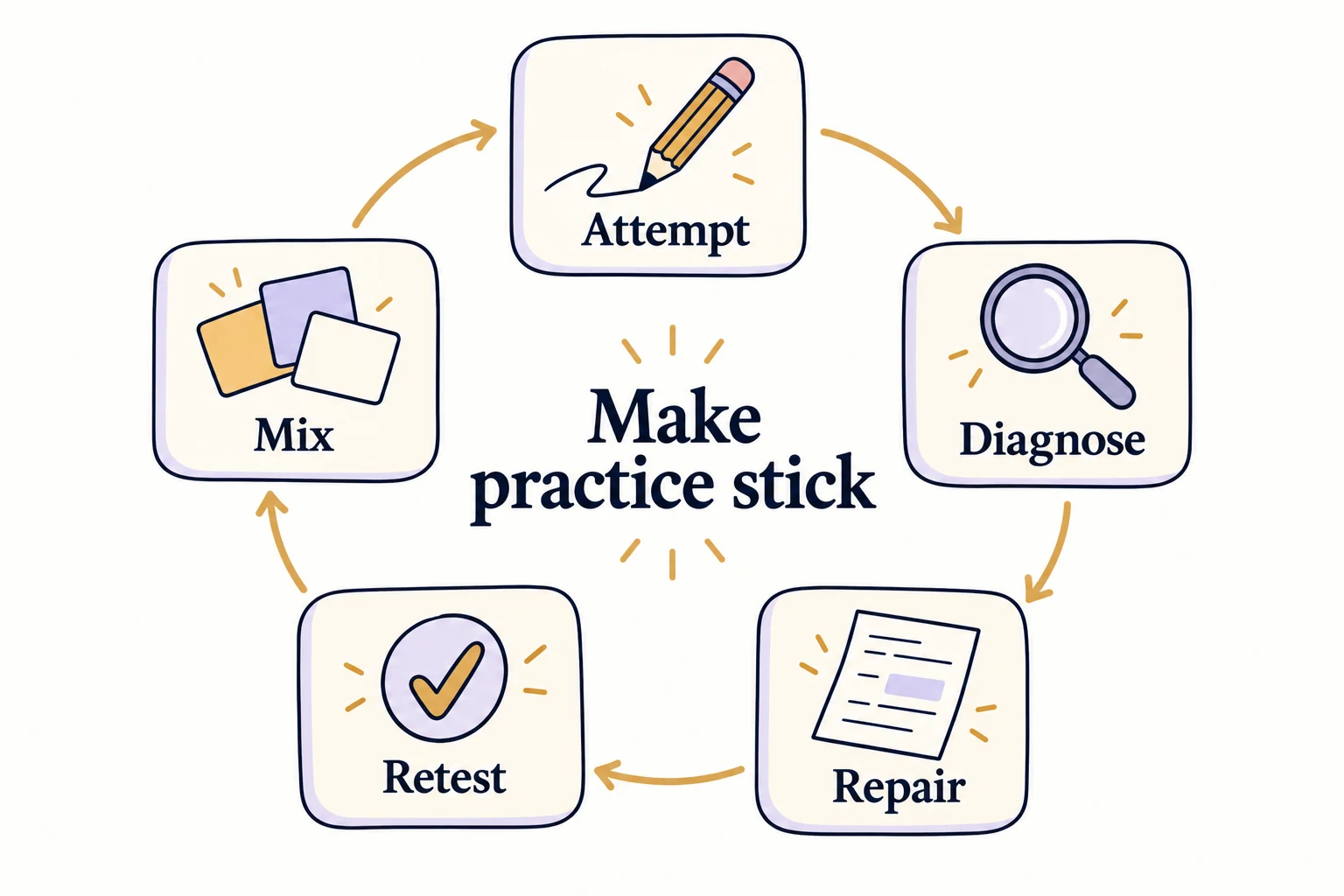
This plan gives that next step a place on the calendar. You will diagnose your starting point, repair a few specific gaps, and return to them in mixed practice. You will also learn when to use algebra, when a graph helps, and when a calculator result needs a closer look.
Eight weeks is the example timeline. If you have four weeks, twelve weeks, or only a short window before the test, use the adjustments near the end. No schedule can promise a particular score increase. It can give you clearer decisions about the work you do today.

Know the Test Before You Plan
The standard digital SAT Math section has 44 questions in two 35-minute modules. The full SAT has 134 minutes of working time plus a 10-minute break between Reading and Writing and Math. That makes a standard full practice sitting 144 elapsed minutes. Approved accommodations can change the timing; use your own approved conditions. These details come from the College Board test structure overview.
Math is adaptive: your first-module performance influences the second module you receive. Scoring also considers characteristics such as question difficulty and answer patterns. Two students with the same number correct can receive different scores. Raw counts still help you compare carefully matched practice sets, but there is no universal conversion from questions correct to a scaled score. Use the official scoring explanation when interpreting practice results.
During a module, work on the question in front of you. Trying to infer your eventual score from how difficult a question feels uses time without resolving the problem. Receiving a harder second module does not, by itself, guarantee a particular score.
The Bluebook testing tools include embedded Desmos, a timer, mark for review, a question menu, and a reference sheet. You can return to questions within the current module. Once that module closes, you cannot revisit it. Practice that navigation before your first serious checkpoint.
Start with a Baseline You Can Learn From
Choose a full-length adaptive test from the official Bluebook practice tests. Prefer one you have not seen. Use the device you expect to use on test day, keep your phone away, and follow the test's timing and break. Keep numbered scratchwork so that you can reconstruct what you tried.
An unseen test gives you more useful evidence of independent performance. A familiar test can still help you rehearse methods, but recognizing an answer can inflate your apparent progress. Mark remembered items when you review. If you have already used the available tests, build diagnostic sets from the Student Question Bank, checking for questions you recognize. The bank supplies existing official questions and filters for assessment, section, domain, skill, and difficulty. It does not generate new questions or guarantee that every item will be unfamiliar.
After the test, open My Practice to review the questions and explanations. Include wrong answers, uncertain correct answers, and questions that took unusually long. An educated guess may reveal useful partial knowledge. A blind guess gives you little evidence of understanding. Record the difference instead of putting every correct answer into the same bucket.
Review your scratchwork before reading the explanation. What was the first step you could not justify? If your equation was correct and the arithmetic failed later, you need a different repair from someone who could not translate the prompt. If you solved accurately but spent several minutes expanding an expression, method choice may deserve attention.
For each reviewed question, record the skill and the cause. Use these categories as prompts rather than permanent labels:
- Concept gap. You could not explain the relevant rule, relationship, or method. Study a short lesson or worked example, then attempt a new problem.
- Translation or interpretation. You chose the wrong quantity, missed a condition, or built an equation that did not match the words. Practice naming variables and restating the question.
- Execution. Your method was sound, but a sign, arithmetic step, copied value, or calculator entry went wrong. Identify the exact step and add a useful check.
- Pacing or method choice. You could solve the problem, but your approach left too little time for the rest. Compare another method on a similar question.
One question can expose several causes. You do not have to force a verdict. Write what the scratchwork supports, repair the earliest clear problem, and see whether the next attempt confirms your diagnosis. “Careless” alone is too vague to guide tomorrow's session.
Choose two priorities from this inventory. Prefer gaps that recur or block other work. “Get better at Algebra” is too broad. “Translate fixed-fee word problems into linear equations” is small enough to practice. “Keep denominator restrictions when simplifying rational expressions” is another useful target.
A baseline is a map with missing detail. You will update it. If a topic looked weak because you met one unfamiliar question, several new attempts may change that judgment. If a topic looked secure because you guessed correctly twice, review may reveal a gap. Let the evidence become more specific as you work.
The Four Domains and Your Priorities
The official Math overview gives the approximate distribution below. These are ranges, not an exact promise for a particular test form. The study topics are practical groupings to help you organize review.
| Domain | Approximate questions | Topics to check in your inventory |
|---|---|---|
| Algebra | 13–15 | Linear equations, inequalities, systems, linear functions, interpreting models |
| Advanced Math | 13–15 | Equivalent expressions, quadratics, nonlinear equations and functions |
| Problem-Solving and Data Analysis | 5–7 | Ratios, rates, percentages, units, probability, statistics, interpreting data |
| Geometry and Trigonometry | 5–7 | Area, volume, circles, angles, triangles, right triangle trigonometry |
Use both the distribution and your own results. Algebra deserves substantial attention when its foundations are weak because those skills support many later methods. But a student who consistently handles equations and repeatedly misses circle questions should address circles early. A smaller domain can still contain your most useful next repair.
For a starting allocation, give about 60 percent of focused practice to your first priority and 30 percent to your second, keeping the rest for older material. These percentages are planning suggestions, not a tested optimum. Count the retrieval work inside your sessions as part of that older-material review. You do not need to calculate every minute precisely.
Do not wait for a topic's named week if it is already blocking you. The sequence below puts geometry in week five to make the plan readable. A geometry gap found at baseline can enter a short review slot in week one. Likewise, you can stay with linear equations longer if fractions and signs still make them unreliable.
Free instruction is available through Khan Academy's official SAT prep. Use a lesson for the specific gap you found, then return to independent questions. Completing an entire course before attempting any problems would delay the feedback you need to choose your next lesson.
Build a Study Session You Can Repeat
The example budget is five hours a week. A standard week contains five 45-minute sessions and one 75-minute review block. A full-test week uses a different allocation so that the practice test fits inside those five hours.
Here is one useful 45-minute session:
| Stage | Minutes | Task |
|---|---|---|
| Retrieve | 5 | Try an older skill without notes. |
| Learn or inspect reasoning | 10 | Study one lesson or worked example and explain the steps. |
| Attempt independently | 15 | Solve new questions on the current priority. |
| Review | 10 | Check the reasoning and identify specific errors. |
| Record and schedule | 5 | Write the next action and choose a later retest. |
Treat this as a template. A difficult concept may need a session devoted largely to instruction. A timed mixed set may need a longer review afterward. You can move stages between sessions, provided the week includes independent attempts, useful feedback, and later checks. There is no requirement to squeeze all five stages into every sitting.
If 25 minutes fits your day better, try 3 minutes of retrieval, 6 of worked reasoning, 9 of independent practice, 5 of review, and 2 of recording. On a particularly busy day, a shorter check can keep one weak skill in view. Choose a workload that leaves room for school, other SAT preparation, and ordinary life.
Why return to old questions after a delay? A major review of learning techniques by Dunlosky and colleagues rated practice testing and distributed practice highly across the research it assessed. That supports including retrieval and spaced review. It does not validate this exact eight-week schedule or predict an SAT score gain.
During the worked-example stage, cover the solution and try the first step. Then compare. If you cannot explain why a line follows from the previous one, pause there. Reading the final answer several times will not resolve a missing relationship.
During independent practice, finish your attempt before opening the explanation. You can use the tools allowed on the test, including the embedded calculator when practicing in Bluebook. “Independent” means you chose and carried out the method without receiving the solution.
During review, ask one concrete question: what would make my next attempt different? “Be careful” offers little help. “Write the denominator restriction before canceling” gives you an action. “Write the requested unit beside the answer box” does too.
Keep the log short enough to use. A question identifier, skill, observed error, and next action are usually sufficient. You can immediately redo a missed item to rehearse the repair. Later, use a different problem to find out whether you can recognize and apply the method without remembering the answer.
Your Eight-Week Digital SAT Math Study Plan
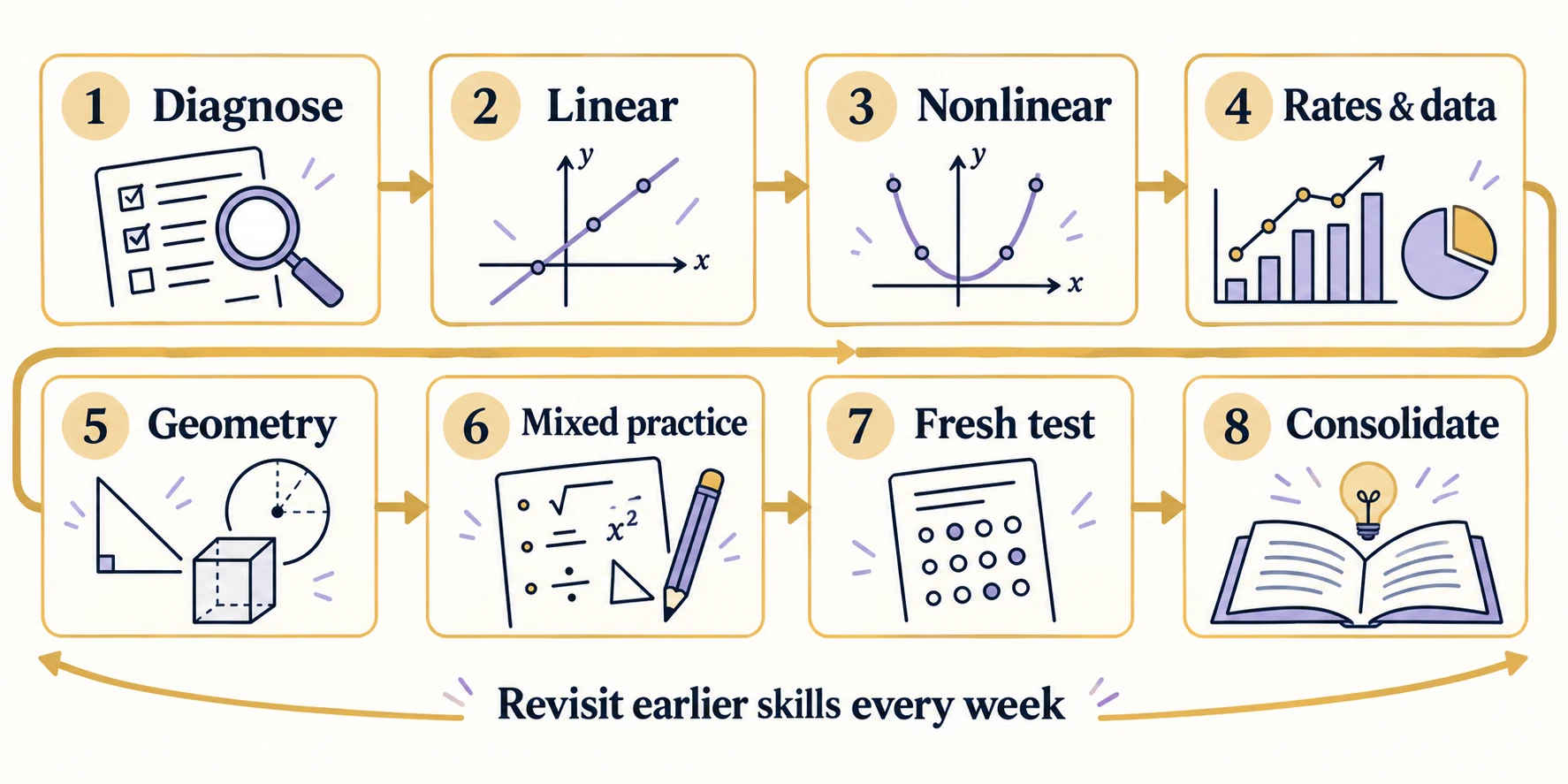
The weeks below have a focus, a task, and a checkpoint. Moving forward means changing the emphasis; it does not mean abandoning an unfinished skill. Keep a small amount of older work in each week, and move a major gap forward if it still needs instruction.
| Week type | Allocation | Total |
|---|---|---|
| Standard practice week | Five 45-minute sessions plus 75-minute review | 300 minutes |
| Standard full-test week | 144-minute test, 60-minute review, two 45-minute repair sessions | 294 minutes |
| Mixed-check week | Five 45-minute sessions, 35-minute check, 40-minute review | 300 minutes |
The full-test allocation assumes standard timing. If your approved timing or review takes longer, reduce the remaining practice or spread the work across more days. Do not shorten the official test to make a spreadsheet total work. Review can continue in the next session if one hour is insufficient.
If you miss a session, carry its most useful task into the next one and reduce optional question volume. Do not automatically double tomorrow's workload. Keep the review of existing work visible; an expanding pile of unchecked questions makes it harder to decide what to do next.
Week 1: Diagnose and Repair Foundations
Take your baseline and build the inventory. In this version of week one, use the full-test allocation: the test, one review block, and two repair sessions. If you already completed and reviewed a fresh baseline, use a standard practice week instead.
Choose two priorities. Use the first repair session for the gap that blocks the most other work, such as manipulating fractions in equations or understanding what a variable represents. Work through one clear example, then attempt a small set of similar questions. Stop adding questions when you have enough work to review within the session.
Use the second session to check that first repair without notes and begin the second priority. If the first gap remains, it can occupy both sessions. You do not need to start a harder topic merely because it appears later in the calendar.
Checkpoint: Can you name the two priorities precisely, show an example of each error, and describe the next action? That is a useful first-week result even if the inventory is still incomplete.
Week 2: Linear Equations, Inequalities, and Systems
Focus on choosing and building equations. For a word problem, name the unknown and its unit before writing symbols. Identify which quantity is fixed, which changes, and what the question actually asks you to report. Example A below demonstrates this with a fixed fee.
For systems, practice substitution and elimination. Ask why a chosen step helps: adding equations eliminates a variable only when the coefficients combine appropriately. After solving, substitute into both original equations. Example B gives you a short case to start with.
Include inequalities if they appeared in your inventory. Pay particular attention to reversing the inequality when multiplying or dividing both sides by a negative number. Check a candidate value in the original inequality if you are unsure which side of a boundary belongs in the solution.
Use the standard practice budget. Put a few questions from week one's repair into retrieval, and keep a short slot for a baseline gap outside Algebra.
Checkpoint: Try a new linear context and a new system without a worked model beside you. If the equations are still hard to build, continue translation practice next week. If the setup is sound but calculation fails, shift the repair toward the particular execution step.
Week 3: Quadratics and Nonlinear Relationships
Study what different forms reveal. In standard form, a quadratic's constant term gives its value at zero. Factored form helps reveal zeros. Vertex form makes the turning point visible. The same expression can be useful in several forms, depending on the question.
Work on factoring, the quadratic formula, or completing the square according to your current gap. Example D shows completing the square in a height model. Read the requested quantity before calculating: maximum height, time of maximum height, and time at ground level are different questions.
Add rational expressions or radicals if your review points there. With rational expressions, write restrictions before simplifying. A canceled factor does not restore a value that made the original denominator zero. Example E is deliberately built around that issue.
Keep linear retrieval in the week. You can include an old system in a warm-up and revisit an equation-translation error during review. Use the standard five-hour allocation, adjusting instruction time if several ideas are new.
Checkpoint: Explain what one chosen form tells you, then use it on a new problem. If you can recite the vertex formula but cannot connect its result to the prompt, practice interpretation alongside calculation.
Week 4: Rates, Percentages, and Data
Work with units and bases explicitly. A rate needs a numerator and denominator. A percentage needs a reference quantity. In consecutive percentage changes, that base may change after the first step. Examples C and G give you models for writing the relationships instead of relying on intuition.
Include data questions with tables or graphs. Before calculating, read the axis labels, scale, units, and population or group being described. Decide whether the question asks for an exact value, an estimate, a comparison, or an interpretation. For statistics, distinguish mean from median; Example H makes the difference visible with a small data set.
This is your midpoint check. You can use a fresh full Bluebook test with the full-test budget, or a 35-minute mixed diagnostic set followed by 40 minutes of review. The mixed set replaces the standard weekly review block. It is not an official adaptive module and does not provide an official scaled score.
Checkpoint: Compare the new error inventory with baseline. Were the old gaps tested by unfamiliar questions? Did the same mistake recur? Keep a priority when the evidence still supports it, and replace it when another gap now deserves more attention. One good result on one question is encouraging, but a thin basis for declaring an entire topic secure.
Week 5: Geometry and Trigonometry
Begin with the geometry gaps you actually found. Check your knowledge of area and volume, angle relationships, circles, similar triangles, and right triangle ratios. Consult the current Bluebook reference sheet during practice so that you know what it provides and how to use it.
Draw or annotate a diagram. Label the quantity given and the quantity requested. A diameter of 12 gives a radius of 6; confusing those two changes a circle area calculation substantially. With right triangles, identify the hypotenuse and label opposite and adjacent relative to the angle you are using before choosing a ratio.
Practice scaling. A doubled length does not imply doubled area or volume. Write the relevant formula and compare the original and changed quantities. Example F shows the reasoning for a circle, then extends it to a sphere.
Use the standard practice budget. Retrieve some quadratics and percentages alongside geometry. If geometry is already a strength, use this week's larger practice slots for your remaining priority and retain a small geometry check.
Checkpoint: Can you choose an appropriate relationship from a new diagram, label it correctly, and explain what your answer measures? If you know the formulas but choose the wrong one, another page of formula copying is unlikely to address the immediate problem.
Week 6: Mixed Work and Method Choice
Mix domains so that the topic label no longer tells you which method to use. Time a set, keep your scratchwork, and review the decisions as well as the answers. Notice where you continued with a slow approach even after it stopped producing useful progress.
Choose a few questions for method comparison. Solve a system with algebra and with a graph. Inspect a quadratic in a useful algebraic form and in Desmos. You do not need two solutions for every question. Use comparisons where you are unsure which approach is more dependable.
Write a short method list based on what you observed. For example: “When coefficients already cancel, try elimination,” or “For a requested maximum, inspect vertex form.” Keep the conditions attached. “Always graph systems” is less useful because some systems are quicker to solve directly, and some require exact reasoning beyond reading a graph.
Practice marking a question and returning within the current module. A return plan needs a usable note, such as the equation you reached or the uncertainty you want to check. Reopening a question with no memory of your first attempt costs more time.
Checkpoint: Compare accuracy and time on new mixed work. If speed rose because you skipped reasoning and guessed more, that is a different result from solving accurately with a shorter method. Keep repairing content when mixed practice exposes a concept gap.
Week 7: Fresh Practice and Targeted Repair
Use a fresh full Bluebook test if one is available. Follow your applicable timing and use the same practical conditions as baseline. This rehearsal also checks whether your device, calculator habits, scratchwork, and navigation feel familiar.
Use the full-test budget and give review its own block. Compare the inventories rather than only the headline scores. A higher score with the same recurring translation error still leaves a useful repair target. A similar score with fewer foundational errors may also show a change worth examining, especially if different topics appeared.
Spend the remaining two sessions on the most relevant unresolved gaps. Keep the work narrow enough to review: one concept, a few attempts, a clear correction, and a later check. If review needs longer, reduce a repair session. The six spare minutes in the example budget are breathing room, not another assignment.
Checkpoint: Choose a short list for the final week. Include both a skill to maintain and an execution habit to remember. “Check whether the question asks for x or 2x” is easier to act on than “stop making silly mistakes.”
Week 8: Consolidate and Prepare
You can use a lighter example budget this week: three 25-minute review sessions and one 45-minute preparation block, totaling two hours. This is optional. Adjust it around your remaining needs, school workload, and test date.
Use short mixed sets, revisit recurring errors, and rehearse familiar methods. You may still repair a small gap, but opening several large new topics at once can leave little time to practice them independently. Choose what you can actually complete and check.
In the preparation block, follow the official device instructions linked later in this guide, check current test-day requirements, and plan your morning. Leave time to resolve a setup problem rather than discovering it as you leave home.
Checkpoint: Can you describe your opening routine, the tools you will use, and what you will do when a question stalls? Your last session can be brief: attempt a few familiar skill types, check your work, read the short method list, and stop at the time you planned.
Eight Worked Examples with Mistakes to Watch For
These eight examples are original practice examples, not official questions. They are designed to show the full reasoning process, a possible wrong step, and how to correct it. Study them in the worked reasoning segment of your sessions. Do not just read them. Cover the solution, attempt the problem, and compare your work.
Example A: Linear Context with a Fixed Fee
Problem: A community club charges a fixed membership fee of $18 plus $7 per session attended. If a member paid $67 in total for one month, how many sessions did they attend?
Setup: Let s be the number of sessions. The total cost is the fixed fee plus the per-session charge multiplied by the number of sessions.
18 + 7s = 67
Solution: Subtract 18 from both sides.
7s = 49
Divide by 7.
s = 7
The member attended 7 sessions.
Watch for this: Dividing the total by the per-session charge first. A student might compute 67 ÷ 7 ≈ 9.57 and then try to adjust, or subtract incorrectly and get 67 - 7 = 60, then divide by 18. The error is treating the fixed fee as if it were applied per session or ignoring it entirely. The fixed fee is added once, not multiplied by the number of sessions.
Correction: Identify the fixed quantity and the variable quantity before writing the equation. The fixed fee is 18. The variable part is 7s. The total is their sum. Check your answer by substituting: 18 + 7(7) = 18 + 49 = 67. It works.
Transfer and retest prompt: Write a new problem with a fixed fee of $25 and a per-item charge of $3, with a total of $70. Solve it. The equation is 25 + 3n = 70, so 3n = 45 and n = 15. In three days, solve a different linear context problem from the Student Question Bank without looking at this example.
Example B: System of Linear Equations
Problem: Solve the system:
2x + y = 13
x - y = 2
Setup: The coefficients of y are +1 and -1, so adding the equations will eliminate y.
Solution: Add the two equations.
(2x + y) + (x - y) = 13 + 2
3x = 15
x = 5
Substitute x = 5 into the second equation.
5 - y = 2
y = 3
The solution is (5, 3).
Watch for this: Graphing the two lines and reading the intersection incorrectly because of a bad scale or window. A student might graph both lines but use a window that cuts off the intersection, or misread the grid and report (4, 3) or (5, 2). Another common error is substituting into only one equation and not checking the other.
Correction: After finding the solution algebraically, back-substitute into both original equations. For (5, 3): 2(5) + 3 = 13, and 5 - 3 = 2. Both check. If you graph, set the window to include the intersection and verify the coordinates against both equations.
Transfer and retest prompt: Solve the system 3x + 2y = 16 and x - 2y = 0. Use elimination first, then check by substitution. Adding gives 4x = 16, so x = 4. Substituting into x - 2y = 0 gives 4 - 2y = 0, so y = 2. The solution is (4, 2). In a later session, solve a system word problem and explain why your solution satisfies both conditions.
Example C: Consecutive Percent Changes
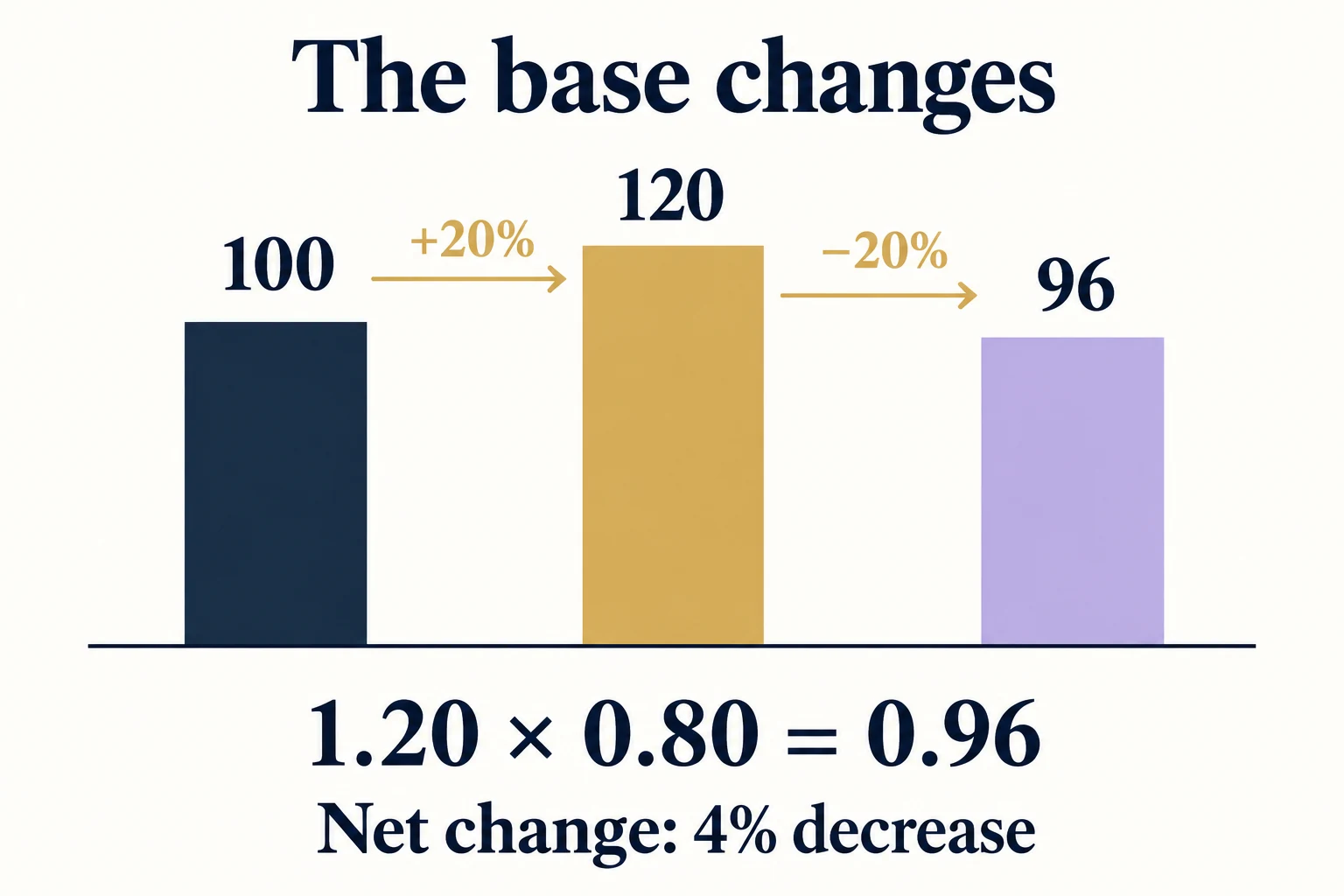
Problem: A quantity starts at 100. It increases by 20%, then decreases by 20%. What is the final value, and what is the net percent change?
Setup: A 20% increase multiplies by 1.20. A 20% decrease multiplies by 0.80. The second percentage applies to the new value after the first change, not to the original.
Solution: Apply the first change.
100 × 1.20 = 120
Apply the second change to 120.
120 × 0.80 = 96
The final value is 96. The net change is 96 - 100 = -4, which is a 4% decrease.
The general multiplier is 1.20 × 0.80 = 0.96. A multiplier of 0.96 means a 4% decrease from the original.
Watch for this: Assuming the two changes cancel. A student might reason that a 20% increase followed by a 20% decrease returns to the original value. This is wrong because the second 20% applies to 120, not 100. Twenty percent of 120 is 24, not 20.
Correction: Always identify the base for each percentage. The first base is 100. The second base is 120. Write the multipliers and multiply them. A net multiplier of 0.96 means a 4% decrease, not a 0% change.
Transfer and retest prompt: Start with 80. Increase by 20%, then decrease by 20%. The first step gives 80 × 1.20 = 96. The second gives 96 × 0.80 = 76.8. The net multiplier is still 0.96. In a later session, solve a problem with a 10% increase followed by a 10% decrease. The multipliers are 1.10 and 0.90, and their product is 0.99, so the result is a 1% decrease, not zero.
Example D: Quadratic Vertex and Interpretation
Problem: A hypothetical model gives the height of an object as h(t) = -5t² + 20t + 1, where t is time in seconds and t ≥ 0, and h is height in meters. The model is valid while the object is above the ground. Find the maximum height and the time at which it occurs. Also find h(0).
Setup: The function is a downward-opening parabola because the coefficient of t² is negative. The maximum occurs at the vertex. Complete the square to write the function in vertex form.
Solution: Factor -5 from the first two terms.
h(t) = -5(t² - 4t) + 1
Complete the square inside the parentheses. Half of -4 is -2, and (-2)² = 4.
h(t) = -5(t² - 4t + 4 - 4) + 1
h(t) = -5((t - 2)² - 4) + 1
h(t) = -5(t - 2)² + 20 + 1
h(t) = -5(t - 2)² + 21
The vertex is at t = 2, and the maximum height is 21 meters. At t = 0, h(0) = -5(0 - 2)² + 21 = -5(4) + 21 = 1, or directly from the original: h(0) = 1.
Watch for this: Confusing the vertex with the roots. A student might set h(t) = 0 and solve for t, then report the roots as the time of maximum height. The roots are the times when the height is zero, not when it is at its peak. For this model, the roots are not integers, and they are irrelevant to the maximum height question.
Correction: Identify what the question asks. Maximum height means vertex. Height of zero means roots. The vertex form reveals the vertex directly. The constant term in the original function gives h(0).
Transfer and retest prompt: For h(t) = -2t² + 12t + 5, find the vertex form, the maximum height, and h(0). Complete the square: h(t) = -2(t² - 6t) + 5 = -2((t - 3)² - 9) + 5 = -2(t - 3)² + 18 + 5 = -2(t - 3)² + 23. The peak is 23 at t = 3, and h(0) = 5. In a later session, explain the difference between the vertex and the roots to a study partner.
Example E: Rational Expression and Domain
Problem: Solve the equation (x² - 9)/(x - 3) = 6.
Setup: The denominator cannot be zero, so x ≠ 3. For any allowed x, the numerator factors as (x - 3)(x + 3), and the expression simplifies.
Solution: For x ≠ 3, (x² - 9)/(x - 3) = ((x - 3)(x + 3))/(x - 3) = x + 3.
Set the simplified expression equal to 6.
x + 3 = 6
x = 3
But x = 3 is not in the domain. The original expression is undefined at x = 3. Therefore, the equation has no solution.
Watch for this: Canceling the (x - 3) factors and accepting x = 3 as the answer. Cancellation is only valid when the canceled factor is not zero. At x = 3, the original denominator is zero, so the original equation is undefined. The candidate solution violates the domain.
Correction: Always state the domain restriction before simplifying. Any candidate solution that violates the domain must be rejected. If all candidates are rejected, the equation has no solution. Check your answer in the original equation, not the simplified one.
Transfer and retest prompt: Solve (x² - 4)/(x - 2) = 5. State the domain restriction first. The domain is x ≠ 2. For x ≠ 2, the expression simplifies to x + 2, so x + 2 = 5 and x = 3. Since 3 is allowed, the solution is x = 3. In a later session, solve a rational equation where the candidate solution is allowed, and explain the difference.
Example F: Circle Scaling and Area
Problem: A circle has radius 3. If the radius is doubled to 6, by what factor does the area increase?
Setup: The area of a circle is A = πr². Doubling the radius means the new radius is 2r.
Solution: Original area: A = π(3)² = 9π.
New area: A = π(6)² = 36π.
The factor is 36π / 9π = 4.
The area increases by a factor of 4, not 2.
Watch for this: Assuming area scales linearly with radius. A student might reason that doubling the radius doubles the area. This is false because the radius is squared in the area formula. Doubling the radius multiplies the area by 2² = 4. The circumference does double: C = 2πr, so doubling r doubles C. The distinction between linear and squared scaling is the point.
Correction: Write the formula. Substitute the old and new radii. Compare the results. The factor is the square of the radius scale factor. If the radius triples, the area increases by a factor of 9.
Transfer and retest prompt: A circle has radius 5. If the radius is tripled, by what factor does the area increase? The area increases by 3² = 9. The circumference increases by 3. In a later session, solve a problem involving the volume of a sphere. Doubling the radius of a sphere multiplies the volume by 2³ = 8, because volume scales with the cube of the radius.
Example G: Rate Conversion with Units
Problem: A car travels at 90 kilometers per hour. How many meters does it travel in 4 minutes?
Setup: Convert kilometers per hour to meters per minute. There are 1000 meters in a kilometer and 60 minutes in an hour.
Solution: Convert the speed.
90 km/hour × 1000 m/km × 1 hour/60 minutes = 1500 m/minute
Now multiply by the time.
1500 m/minute × 4 minutes = 6000 m
The car travels 6000 meters in 4 minutes.
Watch for this: Mixing up the conversion factors. A student might multiply by 60 instead of dividing, getting 90 × 1000 × 60 = 5,400,000 m/minute, which is far too large for this speed. Or they might divide by 1000 and multiply by 60, getting 5.4 m/minute. Writing the units explicitly and canceling them prevents both errors.
Correction: Set up the conversion as a chain. Write each factor with its units. Cancel the units that appear in both numerator and denominator. The remaining unit should be the one you want. If the units do not cancel correctly, the factor is upside down.
Transfer and retest prompt: Convert 72 km/hour to meters per second. First convert: 72 km/hour × 1000 m/km × 1 hour/3600 seconds = 20 m/sec. Then find the distance traveled in 10 seconds: 20 m/sec × 10 sec = 200 m. In a later session, solve a rate problem involving minutes to hours and explain your unit cancellation.
Example H: Mean, Median, and Outliers
Problem: Consider the illustrative data set: 2, 3, 3, 4, 18. Find the mean and the median. Then change the 18 to 28 and find the new mean and median.
Setup: The mean is the sum divided by the count. The median is the middle value when the data are ordered.
Solution: Original sum: 2 + 3 + 3 + 4 + 18 = 30. Count: 5. Mean: 30 / 5 = 6.
The ordered data are 2, 3, 3, 4, 18. The median is the third value, which is 3.
Change 18 to 28. New sum: 2 + 3 + 3 + 4 + 28 = 40. New mean: 40 / 5 = 8.
The ordered data are 2, 3, 3, 4, 28. The median is still the third value, which is 3.
Watch for this: Assuming the median changes when an extreme value changes. The median depends on the middle position, not the magnitude of the extremes. Changing 18 to 28 shifts the mean from 6 to 8 but leaves the median at 3. A student might also confuse the mean and median, reporting 6 as the median because it is the "average."
Correction: Compute the mean and median separately using their definitions. The mean is sensitive to outliers. The median is resistant. Here, changing the largest value changes the total without changing the middle position.
Transfer and retest prompt: For the data set 5, 7, 7, 9, 30, find the mean and median. The sum is 58, so the mean is 11.6. The median is the third value, 7. Change 30 to 50 and recompute. The new sum is 78, so the new mean is 15.6. The median remains 7. In a later session, explain to a study partner why the median did not change.
Choose Methods Deliberately, Including Desmos
Use the embedded calculator during practice so that entering an expression, graphing a function, and finding an intersection feel familiar. The official Bluebook tools page is the starting point for the tools available in the testing environment.
Consider Example B. Adding the equations immediately eliminates y, so hand algebra is short. Graphing both lines can verify the solution, but opening a graph, entering equations, and adjusting the window may add work. For a different system, a graph may be the more practical route. Your practice should help you distinguish those situations.
A graph can also help you understand a quadratic. You can inspect its turning point and compare that with the vertex form you found. But approximate visual readings need care when the question requires an exact value. Decide what precision the answer needs, then verify the candidate in the original relationship.
Keep restrictions visible. In Example E, simplifying the rational expression creates a line except at an excluded input. A graphing view may not make that missing point obvious. The original denominator still decides whether a candidate is allowed. A smooth-looking graph does not remove the restriction.
Calculator mistakes belong in the log too. Perhaps a negative number needed parentheses, or you entered a value from the wrong line. Repeating an entry without checking its structure can repeat the same error. Compare the displayed expression with your written setup before accepting the result.
If you bring a handheld calculator, check the current College Board calculator policy, including restrictions on prohibited features such as CAS functionality. The embedded scientific and graphing Desmos calculator is available throughout Math. Learn the tools you plan to use rather than assuming two calculators behave identically.
Keep an Error Log That Changes Your Next Session
An error log can be a notebook page or a simple table. It needs to help you choose work. It does not need a complicated dashboard, a color system, or a record of every correct answer.
Here are illustrative entries based on the kinds of errors discussed above. They are examples, not records of an actual learner.
| When and source | Skill | Observed error | Repair and later check |
|---|---|---|---|
| Day 1, original Example C | Consecutive percentages | Applied the second change to the starting value | Write the multiplier chain; try a new percentage pair next session. |
| Day 1, original Example F | Circle scaling | Multiplied area by the radius scale factor | Substitute both radii in the area formula; retest with a different scale factor. |
| Day 3, practice set and saved question ID | Linear system | Found a pair that satisfied only one equation | Substitute into both equations; check a new system several days later. |
| Day 3, original Example H | Mean and median | Used the sum to answer a median question | Order the data and mark the middle position; revisit in a mixed set. |
Save enough source information to find a question again. A question ID is better than “that hard algebra question.” If you used an official test, record the test and question identifier without copying an entire bank of questions into your notes.
The next-action column should change your behavior. “Practice percentages” is a topic. “Identify the base before writing each multiplier” is a repair. You can test whether you carried out the repair by looking at your next page of scratchwork.
Review uncertain correct answers as well. If you narrowed four options to two using a sound idea, record the missing step that prevented a complete solution. If you guessed because time ran out after a long setup, investigate pacing. A blind guess can come from a missing concept, a navigation decision, or simple lack of time; the guess alone does not tell you which.
For later checks, try one new problem in the next session, another several days later, and a mixed application the following week. These are adjustable intervals. If you still need instruction, spend time on it. If a skill is becoming dependable, let it appear less often while keeping occasional mixed review.
A failed retest gives you a new question to investigate. Did you forget the relationship, misidentify the problem type, or repeat the same execution step? Return to that specific issue. Re-reading the entire chapter may be unnecessary when one condition is causing trouble.
Keep immediate redo and later transfer separate. Re-solving the same item after feedback is useful rehearsal. Solving an unfamiliar item after a delay gives stronger evidence that you can select and use the method independently. Both have a role, and they answer different questions.
Adjust the Plan to the Time You Have
With two weeks, choose a narrow goal. Review a recent fresh baseline if you have one; otherwise budget for a diagnostic before choosing priorities. Spend the middle days on the most relevant gap, short mixed retrieval, and review. A later checkpoint can be a mixed set instead of a second full test if time or fresh material is limited. Reserve a preparation block before test day. There is no reliable way to predict a score change from this compressed schedule.
With four weeks, combine the emphasis rather than doubling every assignment. Week one can cover baseline, foundations, and linear work. Week two can combine the most relevant nonlinear and data skills. Week three can address geometry and mixed method choice. Week four can include a full rehearsal early enough to review it, followed by narrow repairs and preparation. Keep the same weekly time budget and select topics using your inventory.
With twelve weeks, add four weeks where the evidence calls for them. You might spend an extra week each on linear relationships, nonlinear functions, data, and geometry. Or you might need two extra foundation weeks and two later weeks of mixed practice. Repeating a week should introduce new attempts and later checks, not merely replay the same worksheet.
If you have less than five hours a week, reduce the number or length of sessions. Keep independent work and review connected. For example, four 25-minute sessions plus a 40-minute weekly review make 140 minutes. A full official test will not fit inside that budget with review, so schedule extra time deliberately or spread that checkpoint across a longer planning period. Do not call an interrupted or shortened test a standard full simulation.
Broad foundational gaps may require a longer runway than this calendar. Stay with expression manipulation and equation meaning while adding small, manageable applications. Students with isolated gaps can target those directly and maintain stronger topics through mixed work. Neither choice follows automatically from a score band.
When a week goes badly, change one thing you can observe. Shorten the sessions if attendance is the problem. Change the explanation source if a concept remains opaque. Reduce question difficulty temporarily if independent attempts cannot get started. Then check again. You may need a different method, more time, or a smaller target; one disappointing checkpoint cannot distinguish those by itself.
Track Progress Without Chasing Every Score
Use fresh-question performance, explanations, and pacing together. Each tells you something different. A full practice score adds useful context, but one result should not erase the details in your work.
For accuracy, record a fraction as well as a percentage. Eight correct out of ten new systems questions is 80 percent; four correct out of five is also 80 percent, with much less evidence. Note difficulty and whether questions were timed. A rise on easier sets does not establish a rise on harder ones. Prefer roughly comparable sets when you are tracking one skill.
For understanding, explain why the method fits. “I used elimination because the y coefficients cancel” is more informative than “I added the equations because that is the next step.” An explanation can reveal a gap, but fluent speech alone does not establish mastery. Pair it with an independent attempt on a new problem.
For pacing, look at where time went. A module's average time per question is not a deadline for each question. Some are short; others need more work. Notice whether a few stalled questions prevented you from reaching questions you could solve. Rehearse moving on within the module and returning with your scratchwork intact.
If a weakness persists, inspect the repair itself. Did you only read solutions? Did the later practice include the same answers you remembered? Did you choose questions so difficult that every step required help? A teacher, tutor, or different lesson may clarify the underlying idea. Use the next independent attempt to assess whether that explanation helped.
You can also retire unnecessary work. If new mixed questions repeatedly show that a skill is dependable, reduce its dedicated practice and keep occasional retrieval. This frees time for the gaps still visible in your inventory. The plan should become more selective as you learn more about your needs.
Prepare for Test Day Early Enough to Fix Problems
Follow the official Bluebook device preparation instructions for your situation. Check app readiness, required setup, and the current instructions for what to bring. Requirements can depend on how and where you are testing, so use your own official checklist rather than a generic packing list.
Make a practical morning plan. Know how you will get there, allow time for the journey, and put your device and permitted supplies where you can find them. Resolve calculator-policy questions before the last evening.
Choose a sensible stopping time for study. A short final session can include a few mixed questions and a look at your method list. You do not have to reopen every error from eight weeks of work. Focus on a handful of reminders that affect what you will do: read the requested quantity, label units, preserve restrictions, and check a candidate when time allows.
If you later plan another attempt, use your new score report and remembered testing difficulties to update the inventory. Keep the notes that remain useful. You do not need to restart the entire eight-week sequence just because the date changes.
Frequently Asked Questions
How many hours a week should I study for SAT Math?
There is no universal number. This plan uses five hours as a workable example, with lighter and shorter alternatives. Choose the amount you can sustain, leave time for review, and adjust when your practice shows what still needs attention. Twenty-five minutes is an example session length, not a minimum required for learning.
Should I take a full practice test every week?
The example plan uses baseline, a midpoint check, and a later rehearsal. A full test is useful when its results change your priorities and you can review it. More tests can consume time and fresh material that you might otherwise use to address an already identified gap. Choose checkpoints deliberately.
Can I use Desmos for every question?
The embedded calculator is available throughout Math, but you still have to interpret the prompt and choose what to enter. Practice using it for graphing, calculation, and checking. Also keep direct algebra and reasoning available when they are simpler or make restrictions clearer.
What should I study first if my score is low?
Review the actual errors. If fractions, signs, and basic equations repeatedly block your work, begin there. If the gaps are concentrated elsewhere, use that evidence. A score alone does not tell you which explanation or exercise you need next.
What if I have already seen the official practice tests?
Use unfamiliar question-bank items where available and mark questions you recognize. Reused material remains useful for rehearsal, but remembered answers weaken its value as a progress check. Do not convert a custom mixed set into an invented scaled score.
How do I know when to move on?
Look for independent success on new questions after a delay, with reasoning you can explain and pacing you can manage. There is no magic accuracy threshold for every skill. Move the topic into mixed review when the evidence looks dependable, and bring it back if errors recur.
Your first action is concrete: reserve time for a fresh baseline or open the review from one you recently completed. Identify two specific gaps. Choose a repair for the first. That decision starts the plan.
Sources and scope
An AI-assisted guide edited and checked by Aporo. Practice questions, worked examples, illustrative data and proposed routines are original. These are instructional resources, not official questions or calibrated score predictions. Linked sources support the test facts and reference guidance. Illustrations are explanatory, not screenshots or learner results. No score gain is promised.
- College Board: SAT Test Structure
- College Board: SAT Math Overview
- College Board: Bluebook Practice Tests
- College Board: Student Question Bank
- College Board: Khan Academy Official SAT Prep
- College Board: Bluebook Testing Tools
- College Board: Calculator Policy
- College Board: How Scores Are Calculated
- Dunlosky et al. 2013, Psychological Science in the Public Interest
- College Board: Prepare Your Device