Digital SAT Reading and Writing Practice: 20 Original Questions Explained
Practice with 20 original Reading and Writing questions, then use the answer explanations to check the evidence for each choice. The set covers reading, data, transitions and sentence conventions. It is an instructional sampler, not an official or adaptive SAT module, and it cannot predict a scaled score.
Start here
The questions appear first, with answers only later in a separate answer key and explanations section. Work through them without peeking. Mark your answers on scratch paper. An option labeled (no punctuation) means to insert nothing. After the questions, check the quick answer key, then read the explanations for every item you missed and every item you guessed. The explanations identify the evidence, show why each distractor fails, and name a transfer lesson you can apply to other questions.
All passages, names, demonstrations and data are fictional practice material. The real Reading and Writing section uses short passages or passage pairs with one question each. Under standard timing, it has 54 questions in two 32-minute modules. Approved accommodations can change those conditions. This smaller set does not reproduce the official distribution or difficulty.

The 20 Questions
Question 1
A neighborhood archive invited residents to identify people and locations in donated photographs. Staff added residents' descriptions to the catalogue. The project preserved both the pictures and local knowledge that had never been written down.
Which choice best states the main idea?
- A. All the photographs already had complete captions.
- B. The archive stopped accepting photographs.
- C. Residents helped the archive preserve knowledge about its photographs.
- D. Digital files replaced every physical photograph.
Question 2
The researcher praised the new sensor's precision but qualified her praise by noting that it had been tested only indoors. Outdoor trials would be needed before she could recommend it for fieldwork.
As used here, "qualified" most nearly means:
- A. tempered
- B. confirmed
- C. copied
- D. ignored
Question 3
During the same observation period, a student counted 22 bicycles at a campus rack on Wednesday and 8 on Saturday. She recorded only those two counts and did not survey riders or observe any other days.
Which conclusion is best supported?
- A. More people always cycle on weekdays.
- B. A new rack caused cycling to increase.
- C. The campus has exactly 30 cyclists.
- D. More bicycles were counted on Wednesday than on Saturday during the observations.
Question 4
From a distance, the old observatory seemed unchanged. Up close, Lian noticed fresh sealant around a window and a new hinge on the door. A repaired bolt told her more than the familiar skyline did.
What is the function of the final sentence?
- A. It gives the observatory’s construction date.
- B. It emphasizes how small details reveal changes missed from a distance.
- C. It introduces an unrelated building.
- D. It proves that the skyline has changed.
Question 5
In a fictional controlled demonstration, identical open containers each started with 100 milliliters of water. All conditions were held constant except that one container was shaded. After three days, the shaded container held 82 milliliters and the unshaded container held 65.
Which finding supports the claim that shading reduced water loss in this demonstration?
- A. Both containers began with different water volumes.
- B. The shaded container retained 17 milliliters more water.
- C. The unshaded container retained more water.
- D. No water evaporated from either container.
Question 6
Text 1: Digital copies let readers study fragile letters without repeatedly handling the originals. They make the text easier to access.
Text 2: A digital image can show a letter's words, but some research also requires examining its paper, folds, or physical markings.
Which statement would both authors most likely accept?
- A. Digital copies preserve every physical property of letters.
- B. Digital copies make historical research impossible.
- C. Original letters should never be examined.
- D. Digital copies can be useful without replacing every use of originals.
Question 7
The museum removed its entrance fee to make visits more accessible. ______, some families still found the cost of traveling to the museum difficult to manage.
Which transition best fits?
- A. Therefore
- B. However
- C. For instance
- D. Similarly
Question 8
The collection of hand-drawn maps, including several maps of nearby islands, ______ an entire cabinet in the reading room. Staff keep the cabinet locked when the archive is closed.
Which choice completes the text in standard written English?
- A. occupy
- B. have occupied
- C. occupies
- D. are occupying
Question 9
The team labeled each sample carefully______ the labels remained readable after the containers were moved to a new shelf. This made the later inventory easier to complete.
Which choice completes the text in standard written English?
- A. ,
- B. ;
- C. .
- D. , however
Question 10
Notes: Painter A works outdoors. Painter B works in a studio. Both artists use watercolor. Their recent exhibitions contain landscape paintings.
A student wants to emphasize a similarity between their materials.
Which choice best achieves that goal?
- A. Both Painter A and Painter B use watercolor.
- B. Painter A works outdoors, while Painter B works in a studio.
- C. Painter A recently exhibited landscape paintings.
- D. The artists work in different locations.
Question 11
A fictional exhibition recorded visitors from four groups: North 12, South 18, East 15, and West 9. Each visitor belonged to exactly one group. These counts describe this exhibition only.
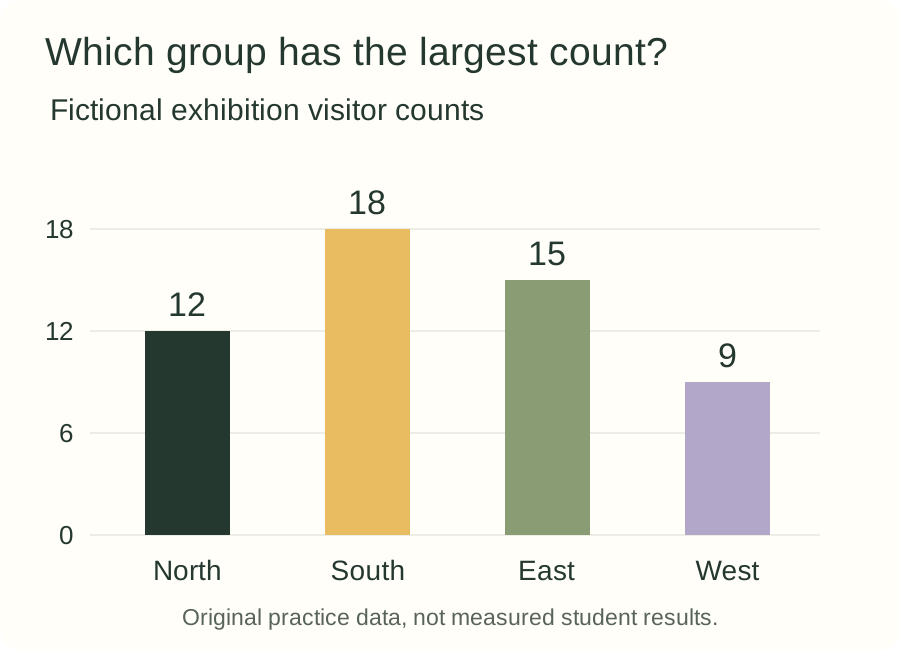
| Group | Visitors |
|---|---|
| North | 12 |
| South | 18 |
| East | 15 |
| West | 9 |
Which statement accurately describes the data?
- A. North had more visitors than East.
- B. West had twice as many visitors as South.
- C. East and West had equal visitor counts.
- D. South had the largest visitor count.
Question 12
An archive entry dates a manuscript to 1780. A later examination finds a watermark design in its paper. In this fictional scenario, that design first became available in 1795, and the paper is confirmed to be original to the manuscript.
If those facts are accurate, which conclusion follows?
- A. The manuscript could not have been written before 1795.
- B. The manuscript was written before 1795.
- C. The author’s identity is now known.
- D. The manuscript was definitely written in 1780.
Question 13
Most umbrellas at the station were gray or black. Against that muted background, Amira's bright orange umbrella was conspicuous. Her friend spotted it immediately from the far end of the platform.
As used here, "conspicuous" most nearly means:
- A. expensive
- B. portable
- C. noticeable
- D. decorative
Question 14
Each of the entries in the catalogue ______ a short description of the object and the date it entered the collection. The descriptions help readers distinguish objects with similar names.
Which choice completes the text in standard written English?
- A. include
- B. are including
- C. have included
- D. includes
Question 15
The team tracked one variable______ how quickly the liquid cooled. Every other condition was held constant during the fictional demonstration, so the notes focused on that single measurement.
Which choice completes the text in standard written English?
- A. ;
- B. because
- C. :
- D. .
Question 16
Two engineers worked on the project: Nadia and Tomas. The engineer______ Nadia designed the frame, while Tomas checked the joints. Their different responsibilities are recorded in the project notes.
Which choice best completes the text in standard written English?
- A. ,
- B. ;
- C. :
- D. (no punctuation)
Question 17
Notes: In a fictional comparison, Panel A was made of wood and weighed 6 kilograms. Panel B was made of aluminum and weighed 4 kilograms. Both panels measured 1 square meter.
A student wants to compare the panels' masses.
Which choice best achieves that goal?
- A. Both panels measured 1 square meter.
- B. Panel A weighed 2 kilograms more than Panel B.
- C. Panel A was made of wood.
- D. Panel B was made of aluminum.
Question 18
The archive uses several methods to protect its collection. ______, staff keep light-sensitive photographs in closed boxes when the photographs are not being examined. Other materials require different storage arrangements.
Which transition best fits?
- A. For example
- B. Nevertheless
- C. Instead
- D. Consequently
Question 19
A club leader claimed that a new invitation process increased the percentage of invited people who attended. Before the change, 12 of 20 invitees attended. After it, 18 of 40 attended. These are the only observations provided.
Which observation most directly challenges the leader's percentage claim?
- A. The attendance percentage fell from 60 percent to 45 percent.
- B. More invitations were sent afterward.
- C. The number attending increased by 6.
- D. Exactly the same number of people were invited.
Question 20
A library surveyed only people visiting before noon about proposed evening hours. Most respondents opposed the change. Staff want to know whether people who would visit in the evening support the proposal, but no evening visitors were surveyed.
Which statement best completes an evaluation of the survey?
- A. It establishes that every resident opposes evening hours.
- B. It proves that evening visitors oppose the proposal.
- C. It does not establish what the unsurveyed evening visitors think.
- D. It guarantees that longer hours would increase attendance.
Quick Answer Key
| Question | Answer | Skill |
|---|---|---|
| 1 | C | Central idea |
| 2 | A | Words in context |
| 3 | D | Inference |
| 4 | B | Text purpose |
| 5 | B | Command of evidence |
| 6 | D | Cross-text connections |
| 7 | B | Transitions |
| 8 | C | Subject-verb agreement |
| 9 | B | Sentence boundaries |
| 10 | A | Rhetorical synthesis |
| 11 | D | Quantitative evidence |
| 12 | A | Inference from chronology |
| 13 | C | Words in context |
| 14 | D | Agreement |
| 15 | C | Colon |
| 16 | D | Identifying information |
| 17 | B | Rhetorical synthesis |
| 18 | A | Transitions |
| 19 | A | Evaluating a claim |
| 20 | C | Logical completion |
Answer Key and Explanations
Question 1: Central Idea
Correct answer: C
The passage describes a project with two parts. Residents identified people and locations in photographs. Staff added those descriptions to the catalogue. The final sentence states the outcome: the project preserved both pictures and local knowledge. Choice C captures that combined outcome. Residents contributed knowledge, and the archive preserved it.
Choice B says the archive stopped accepting photographs. Nothing in the passage mentions stopping, ending, or rejecting donations. The project involved donated photographs, but the passage never says donations ceased.
Choice A says all the photographs already had complete captions. This contradicts the passage. The residents were invited to identify people and locations, which implies the photographs lacked complete information. If captions were already complete, the identification work would have been unnecessary.
Choice D says digital files replaced every physical photograph. The passage never mentions digital files, scanning, or replacement. It discusses adding descriptions to a catalogue, not converting physical items to digital form.
The transfer lesson: a main idea must cover the whole passage, not one detail. When two elements combine, the correct answer often names both. If an answer uses an absolute word like "all," "every," or "never," check whether the passage supports that extreme claim.
Question 2: Words in Context
Correct answer: A
The sentence structure gives the clue. The researcher praised the sensor's precision. Then the word "but" signals a shift. She noted the sensor had been tested only indoors. Outdoor trials would be needed before recommending it for fieldwork. So her praise was limited or restrained. "Tempered" means moderated or softened, which fits that limitation.
Choice B, "confirmed," suggests she strengthened or verified her praise. That would fit if she had said the sensor worked perfectly in all conditions. Instead, she added a restriction. Confirmed praise would not require the "but" contrast.
Choice C, "copied," makes no sense in context. She did not duplicate her praise. The sentence describes how she adjusted her evaluation, not how she reproduced it.
Choice D, "ignored," suggests she disregarded her own praise. She did not ignore it. She stated it and then limited it. The sentence presents praise with a limitation; it does not say she disregarded or withdrew the praise.
The transfer lesson: for words in context, find the surrounding contrast or support. Words like "but," "although," "despite," and "however" signal a shift. The correct meaning must fit the logical relationship, not just be a dictionary definition.
Question 3: Inference
Correct answer: D
The student counted 22 bicycles on Wednesday and 8 on Saturday. Choice D states exactly that observed comparison: more bicycles were counted on Wednesday than on Saturday during the observations. The phrase "during the observations" keeps the claim limited to what the student actually recorded.
Choice A says more people always cycle on weekdays. The word "always" is too strong. The student observed only two days. Two observations cannot establish a universal pattern. The passage also says she did not survey riders, so she counted bicycles, not people.
Choice B says a new rack caused cycling to increase. The passage mentions no new rack, no cause, and no increase. The counts went down from Wednesday to Saturday, but the passage does not explain why. Causation requires evidence the passage does not provide.
Choice C says the campus has exactly 30 cyclists. The student counted 30 bicycles total across two days, but bicycles are not cyclists. The same person could have parked a bicycle on both days, or different people could have used the same bicycle. The passage also says she did not survey riders.
The transfer lesson: a supported inference stays close to the data. It does not add causes, populations, or universal claims. Check words such as always, exactly and caused against the supplied evidence. They are not automatically wrong, but each adds a requirement that the passage must support.
Question 4: Text Purpose
Correct answer: B
The passage sets up a contrast between distance and closeness. From a distance, the observatory seemed unchanged. Up close, Lian noticed fresh sealant, a new hinge, and a repaired bolt. The final sentence says the repaired bolt told her more than the familiar skyline did. That sentence emphasizes the point: small details reveal changes that a distant view misses.
Choice A says the final sentence gives the construction date. No date appears anywhere in the passage. The sentence is about what the bolt told Lian, not about when the observatory was built.
Choice D says the final sentence proves the skyline has changed. The passage never says the skyline changed. It says the skyline was familiar. The contrast is between the unchanged appearance from a distance and the small repairs visible up close.
Choice C says the final sentence introduces an unrelated building. The sentence refers to the same observatory and its details. It does not introduce a new building or shift to a new topic.
The transfer lesson: when a question asks about the function of a sentence, identify what that sentence does in relation to the sentences before it. Does it contrast, emphasize, illustrate, or conclude? The correct answer names that role.
Question 5: Command of Evidence
Correct answer: B
The demonstration used two identical open containers, each starting with 100 milliliters of water. One was shaded, one was not. After three days, the shaded container held 82 milliliters and the unshaded container held 65. The shaded container retained 17 milliliters more because 82 minus 65 equals 17. That difference supports the claim that shading reduced water loss in this demonstration.
Choice A says both containers began with different water volumes. The passage says both started with 100 milliliters. This choice directly contradicts the stated conditions.
Choice C says the unshaded container retained more water. The numbers show the opposite. The unshaded container held 65 milliliters, while the shaded container held 82.
Choice D says no water evaporated from either container. Both containers lost water. The shaded container went from 100 to 82 milliliters, losing 18. The unshaded container went from 100 to 65, losing 35. Evaporation or some other loss clearly occurred.
The transfer lesson: command of evidence questions ask you to find the specific data point that supports a claim. Do the arithmetic when numbers appear. A 17-milliliter difference is the evidence, not a general statement about shading being good.
Question 6: Cross-Text Connections
Correct answer: D
Text 1 emphasizes the benefits of digital copies: they protect fragile originals from handling and make texts easier to access. Text 2 acknowledges that digital images show words but notes that some research requires examining paper, folds, or physical markings. Both authors would accept that digital copies can be useful. Text 1 says so directly. Text 2 implies usefulness by saying digital images can show a letter's words, even though they cannot capture everything. Both would also accept that digital copies do not replace every use of originals. Text 1 does not claim replacement, and Text 2 explicitly says some research still requires originals.
Choice A says digital copies preserve every physical property. Text 2 directly contradicts this by noting that paper, folds, and physical markings may require examination of the original.
Choice C says original letters should never be examined. Neither text says this. Text 1 wants to reduce repeated handling, not eliminate all examination. Text 2 says some research requires examining originals.
Choice B says digital copies make historical research impossible. Both texts suggest digital copies help research, not hinder it. Text 1 says they make access easier. Text 2 says they can show words.
The transfer lesson: for paired passages, find the overlap. The correct answer must be acceptable to both authors. If one author would reject a statement, that answer fails, no matter how well it fits the other text.
Question 7: Transitions
Correct answer: B
The first sentence says the museum removed its entrance fee to make visits more accessible. The second sentence says some families still found travel costs difficult. The relationship is contrast. Removing the fee helped with one barrier, but another barrier remained. "However" signals that contrast.
Choice A, "Therefore," signals a result. It would suggest that removing the fee caused travel costs to become difficult. That makes no logical sense. Removing a fee does not cause travel costs.
Choice C, "For instance," signals an example. The travel cost is not an example of the entrance fee removal. It is a separate barrier that remained after the fee was removed.
Choice D, "Similarly," signals a comparison. The two sentences describe different problems, not similar ones. The first is about an entrance fee, the second about travel costs.
The transfer lesson: identify the logical relationship before choosing a transition. Contrast words like "however," "nevertheless," and "yet" fit when the second sentence qualifies or opposes the first. Result words like "therefore" and "consequently" fit when the second sentence follows from the first.
Question 8: Subject-Verb Agreement
Correct answer: C
The subject of the sentence is "collection." The phrase "of hand-drawn maps" modifies the collection. The phrase "including several maps of nearby islands" also modifies the collection. Neither phrase changes the subject. "Collection" is singular, so the verb must be singular. "Occupies" is the singular present tense form.
Choice A, "occupy," is plural. It would agree with "maps," but "maps" is not the subject. The maps are inside a prepositional phrase.
Choice B, "have occupied," is plural. The auxiliary verb "have" does not agree with the singular subject "collection."
Choice D, "are occupying," is plural. The auxiliary verb "are" does not agree with the singular subject "collection."
The transfer lesson: agreement follows the grammatical subject, not a nearby plural noun. Prepositional phrases like "of hand-drawn maps" and participial phrases like "including several maps" sit between the subject and verb. Cross them out mentally to find the true subject.
Question 9: Sentence Boundaries
Correct answer: B
The blank sits between two independent clauses. "The team labeled each sample carefully" has a subject and verb and expresses a complete thought. "The labels remained readable after the containers were moved to a new shelf" also has a subject and verb and expresses a complete thought. A semicolon can join two independent clauses without a coordinating conjunction.
Choice A, a comma, creates a comma splice. A comma alone cannot join two independent clauses in standard written English.
Choice C, a period, would create two sentences. The problem is that the second clause begins with "the labels" with a lowercase "t." If a period were used, "the" would need to be capitalized. The question presents "the labels" with a lowercase "t," so a period would not produce standard capitalization.
Choice D, ", however," creates a comma splice with a conjunctive adverb. "However" is not a coordinating conjunction. It cannot join two independent clauses with only a comma. The correct form would be "; however," or a period followed by "However," with a capital "H."
The transfer lesson: check what is on both sides of the blank. If both sides are independent clauses, a semicolon works. A comma alone does not. A period works only if the next word is capitalized. When however opens the second independent clause in this construction, it needs an appropriate sentence boundary before it. It can occupy other positions in different sentence structures.
Question 10: Rhetorical Synthesis
Correct answer: A
The student wants to emphasize a similarity between the painters' materials. The notes say both artists use watercolor. Choice A states that similarity directly.
Choice B emphasizes a difference: Painter A works outdoors, Painter B works in a studio. That is about location, not materials, and it highlights a contrast, not a similarity.
Choice C mentions only Painter A and only exhibition content. It does not compare the two artists or their materials.
Choice D also emphasizes a difference in locations. It does not address materials at all.
The transfer lesson: rhetorical synthesis questions ask you to match a specific goal. Read the goal carefully. If the goal is a similarity, eliminate answers that emphasize differences. If the goal is a comparison of one variable, eliminate answers that discuss other variables.
Question 11: Quantitative Evidence
Correct answer: D
The data show four visitor counts: North 12, South 18, East 15, West 9. South has 18 visitors, which is the largest count. Choice D states this accurately.
Choice A says North had more visitors than East. North had 12, East had 15. North had fewer, not more.
Choice B says West had twice as many visitors as South. West had 9, South had 18. West had half as many, not twice as many.
Choice C says East and West had equal visitor counts. East had 15, West had 9. They are not equal.
The transfer lesson: quantitative evidence questions require careful reading of the data. Check each number against the claim. Do not assume a pattern. The correct answer describes the data as given, not a broader population. These counts describe this exhibition only.
Question 12: Inference from Chronology
Correct answer: A
The archive entry dates the manuscript to 1780. A watermark design in the paper first became available in 1795. The paper is confirmed to be original to the manuscript. If the paper is original and the watermark design did not exist before 1795, then the manuscript could not have been written before 1795. The 1780 date must be incorrect.
Choice D says the manuscript was definitely written in 1780. This cannot be true if the paper contains a watermark design that did not exist until 1795.
Choice B says the manuscript was written before 1795. This contradicts the evidence. The watermark design first became available in 1795, so the paper could not have existed before that year.
Choice C says the author's identity is now known. The passage says nothing about the author. The watermark evidence tells us about dating, not authorship.
The transfer lesson: chronology questions ask what must follow from the facts. If a material did not exist before a certain year, anything made from that material cannot predate that year. The correct inference is a necessary consequence, not a guess about identity or an exact date.
Question 13: Words in Context
Correct answer: C
The passage describes a background of gray and black umbrellas. Amira's bright orange umbrella stood out against that muted background. Her friend spotted it immediately from far away. "Conspicuous" means noticeable or easy to see. Choice C fits.
Choice B, "portable," means easy to carry. The passage says nothing about carrying the umbrella. The contrast is about visibility, not portability.
Choice A, "expensive," means costing a lot. The passage says nothing about price. A bright orange umbrella might or might not be expensive, but the context is about visibility.
Choice D, "decorative," means ornamental. The umbrella might be decorative, but the passage emphasizes that it was spotted immediately. The key idea is noticeability, not decoration.
The transfer lesson: context clues come from surrounding words. "Against that muted background" and "spotted it immediately" both point to visibility. The correct meaning must fit those clues.
Question 14: Agreement
Correct answer: D
The subject is "each." "Each of the entries" is singular. The verb must be singular. "Includes" is the singular present tense form.
Choice A, "include," is plural. It would agree with "entries," but "entries" is inside the prepositional phrase "of the entries." The true subject is "each."
Choice C, "have included," is plural. The auxiliary verb "have" does not agree with the singular subject "each."
Choice B, "are including," is plural. The auxiliary verb "are" does not agree with the singular subject "each."
The transfer lesson: identify the grammatical subject, then decide its number. Here each is the subject head. In They each include a description, they is the subject and include is correct. A keyword alone does not choose the verb.
Question 15: Colon
Correct answer: C
The blank follows "one variable." The phrase "how quickly the liquid cooled" identifies that variable. A colon can introduce an explanation, list, or specification after a complete clause. "The team tracked one variable" is a complete clause. The colon introduces what that variable was.
Choice A, a semicolon, requires two independent clauses. "How quickly the liquid cooled" is not an independent clause. It cannot stand alone as a sentence.
Choice B, "because," would create an incomplete construction. "The team tracked one variable because how quickly the liquid cooled" does not work grammatically. "Because" introduces a dependent clause, but the phrase "how quickly the liquid cooled" does not complete the thought in a way that works with "because."
Choice D, a period, would require the next word to be capitalized. The question presents "how" with a lowercase "h." A period before a lowercase word is not standard.
The transfer lesson: a colon works when the first part is a complete sentence and the second part explains, lists, or specifies. A semicolon works only when both parts are complete sentences. Check what follows the blank before choosing.
Question 16: Identifying Information
Correct answer: D
The sentence says "The engineer______ Nadia designed the frame." The name "Nadia" identifies which engineer. The construction "The engineer Nadia" is an appositive-like structure where the name specifies the person. No punctuation is needed. The phrase "the engineer Nadia" works like "my friend Sam" or "the author Toni Morrison."
Choice A, a comma, would create "The engineer, Nadia designed the frame." This is incorrect because a single comma cannot separate a subject from its verb. If commas were used, they would need to be a pair: "The engineer, Nadia, designed the frame." But even that pair is unnecessary here because the name is essential identifying information.
Choice B, a semicolon, would require two independent clauses. "Nadia designed the frame" is an independent clause, but "The engineer" alone is not.
Choice C, a colon, would suggest that "Nadia designed the frame" explains or lists something about "the engineer." A colon does not fit this identifying structure.
The transfer lesson: when a name identifies a person or thing, no punctuation is usually needed. If the name is extra information that could be removed without changing the meaning, use a pair of commas. Here, the name is essential because the sentence distinguishes Nadia from Tomas.
Question 17: Rhetorical Synthesis
Correct answer: B
The student wants to compare the panels' masses. Panel A weighed 6 kilograms, Panel B weighed 4 kilograms. The difference is 2 kilograms. Choice B states that comparison directly.
Choice A mentions the panels' area, not their masses. Both panels measured 1 square meter, but that is not a mass comparison.
Choice C mentions Panel A's material. Wood is a material, not a mass. The fact is true, but it does not compare masses.
Choice D mentions Panel B's material. Aluminum is a material, not a mass. The fact is true, but it does not compare masses.
The transfer lesson: rhetorical synthesis questions test whether you can select the note that matches the stated goal. If the goal is a mass comparison, choose the answer that compares masses. Other true facts are distractors if they do not serve the goal.
Question 18: Transitions
Correct answer: A
The first sentence says the archive uses several methods to protect its collection. The second sentence describes one specific method: keeping light-sensitive photographs in closed boxes. The relationship is general to specific. "For example" introduces a specific instance of a general claim.
Choice B, "Nevertheless," signals contrast. The second sentence does not contrast with the first. It supports the first by giving an example.
Choice C, "Instead," signals replacement. The second sentence does not replace the first. It illustrates it.
Choice D, "Consequently," signals a result. The specific method is not a result of the general claim. It is an instance of it.
The transfer lesson: when a general statement is followed by a specific case, "for example" or "for instance" often fits. Contrast transitions fit when the second sentence opposes the first. Result transitions fit when the second sentence follows from the first.
Question 19: Evaluating a Claim
Correct answer: A
The club leader claimed the new invitation process increased the percentage of invited people who attended. Before the change, 12 of 20 invitees attended. That is 12 divided by 20, or 60 percent. After the change, 18 of 40 attended. That is 18 divided by 40, or 45 percent. The percentage fell, not increased. Choice A states this directly and challenges the leader's claim.
Choice C says the number attending increased by 6. That is true: 18 minus 12 equals 6. But the leader's claim was about percentage, not raw number. A raw number increase can happen even when the percentage falls because the total number of invitees changed.
Choice B says more invitations were sent afterward. That is true: 40 versus 20. But sending more invitations does not support or challenge the percentage claim by itself. The percentage calculation accounts for the different totals.
Choice D says exactly the same number of people were invited. This is false. Twenty people were invited before, 40 after.
The transfer lesson: distinguish between raw counts and percentages. A raw count can rise while a percentage falls. When a claim uses a percentage, check the percentage, not just the count.
Question 20: Logical Completion
Correct answer: C
The survey included only people visiting before noon. The proposal concerned evening hours. Most morning respondents opposed the change. But the survey did not include evening visitors. The staff want to know what evening visitors think. Choice C states the limitation: the survey does not establish what the unsurveyed evening visitors think.
Choice A says the survey establishes that every resident opposes evening hours. The survey included only morning visitors. It cannot establish what all residents think. The word "every" is also too strong.
Choice B says the survey proves that evening visitors oppose the proposal. The survey did not include evening visitors. It cannot prove anything about them.
Choice D says the survey guarantees that longer hours would increase attendance. The survey asked about opinions, not attendance. It also did not include evening visitors. No guarantee is possible.
The transfer lesson: a survey's conclusions are limited by its sample. If a group was not surveyed, the survey cannot establish what that group thinks. The correct answer often names the limitation directly.
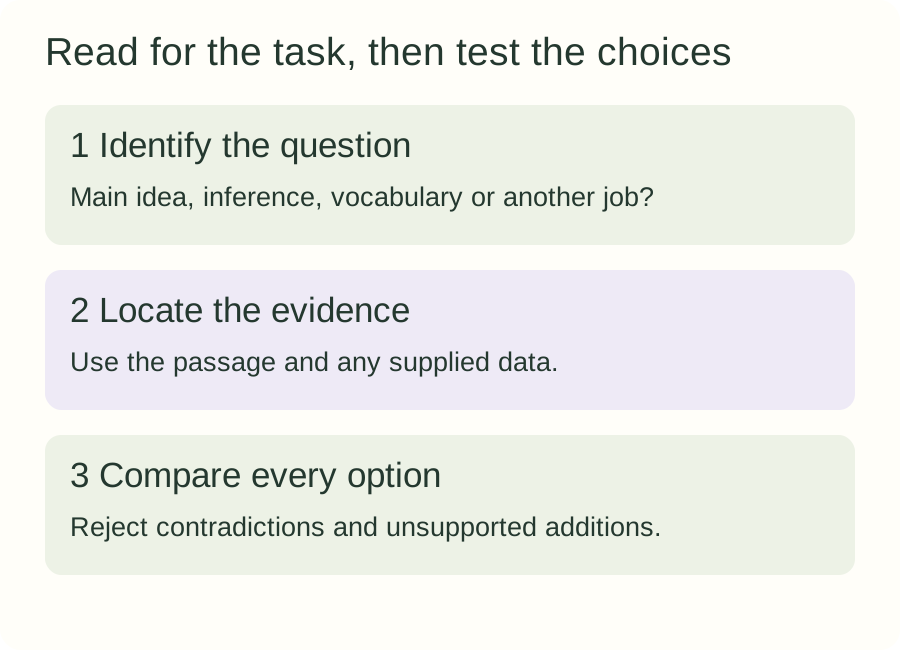
Method FAQs
How should I use these 20 questions?
Use them as a practice sampler. Work through all 20 in one sitting if you can, or split them into two sets of 10. Mark your answers on scratch paper. An option labeled (no punctuation) means to insert nothing. Do not check the key until you finish the set. After checking, read the explanation for every question you missed and every question where you guessed. Write down the skill name and the reason you missed it. Then find official practice for that skill in the College Board Student Question Bank, which lets you filter by domain, skill, and difficulty.
Are these questions like the real digital SAT?
They are original instructional questions. They are not College Board items. They are not validated, not calibrated, and not adaptive. They do not predict your real SAT score. Its length and selection are different from an official module. Use these questions to practice reasoning, not to estimate a score.
Where can I find official practice?
The College Board offers Bluebook, a digital testing application with full-length adaptive practice tests. After completing a Bluebook test, you can review your work in My Practice. The Student Question Bank provides official practice questions filtered by domain, skill, and difficulty. The question bank contains existing official questions and is not itself an adaptive full test. Review what you recognize so remembered answers do not inflate a progress check. Use original articles like this one for extra skill work.
How long should I spend on each question?
There is no hard seconds-per-question rule that works for everyone. An average across a module is not a deadline for every individual item. Some questions take less time, and some take more. The digital test is module-based, and you can move back and forth within a module. Practice finding your natural pace. If a question takes too long, mark it, move on, and return if time allows.
What should I do when I miss a question?
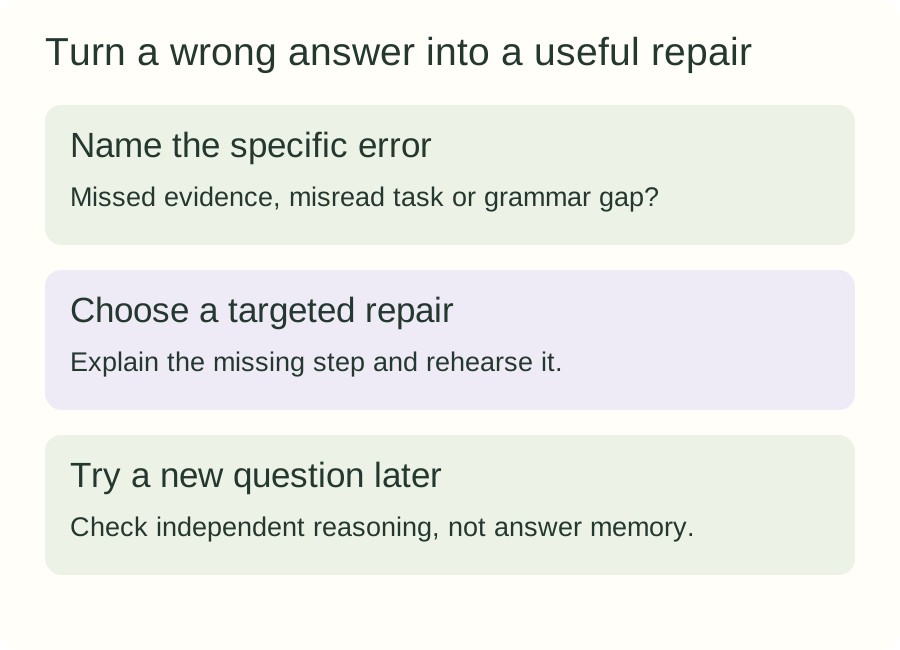
Follow a review process. First, identify the skill. Second, find the evidence in the passage that supports the correct answer. Third, explain why each distractor fails. Fourth, write a one-sentence transfer lesson. Fifth, attempt a new independent question for the same skill. The review map below shows this cycle.
Can I improve my Reading and Writing score quickly?
No article can promise fast score gains. Improvement comes from consistent practice, careful review, and targeted repair. Some skills improve faster than others. If a rule is missing, a short grammar lesson followed by independent questions gives you a specific repair to check. Inference and central idea questions require repeated practice with varied passages. Be patient with yourself.
What grammar topics should I review?
The Purdue OWL clause reference and agreement guide are useful for independent and dependent clauses, commas versus semicolons, and subject-verb agreement. An independent clause contains a subject and a finite verb and expresses a complete thought. A dependent clause cannot stand as a complete sentence. Two independent clauses can be joined by a semicolon, or by a comma plus a coordinating conjunction. A conjunctive adverb such as "however" is not a coordinating conjunction. Agreement follows the grammatical subject, not a nearby plural noun. Try a new sentence after reviewing the rule so you can check whether you can apply it independently.
What about the Math section?
If you are also preparing for Math, a separate study plan can help you organize your practice. The Aporo Math study plan covers that separate section. Use it alongside your Reading and Writing work.
How do I know if I am ready?
Readiness is not about one practice set. It is about consistency across official practice. Take a Bluebook practice test under realistic conditions. Review your errors. Work on weak skills in the Student Question Bank. Repeat. When your official practice scores are stable and your error patterns are shrinking, you are building readiness. No single original article can tell you that.
Review Checklist
Use this checklist after each practice session.
- Did I read the question stem before the passage when the stem was short?
- Did I find specific evidence for my answer?
- Did I eliminate all three distractors with a reason?
- Did I check whether any absolute claim is actually supported, rather than rejecting it solely for containing all, every, never or always?
- Did I distinguish raw counts from percentages?
- Did I check subject-verb agreement by finding the true subject?
- Did I verify that both sides of a semicolon were independent clauses?
- Did I match rhetorical synthesis answers to the stated goal?
- Did I write down the skill for every missed question?
- Did I attempt a new independent question for each weak skill?
Session Options
Option A: Full Sampler
Work all 20 questions in one sitting. Allow yourself about 30 to 35 minutes. Check the key. Read all explanations. Complete the review checklist. These suggested times cover answering only; reserve a separate 30-45 minutes for review, or split the work if you need longer. One short set is limited evidence about a skill.
Option B: Split Sessions
Work questions 1 through 10 in one session and questions 11 through 20 in another. Allow about 15 to 18 minutes per set. Check the key after each set. Read the explanations for that set. Complete the review checklist. Those times cover attempts only. Add a review block of roughly 15-25 minutes, adjusting to the number of explanations you need. These are suggested study budgets, not tested optimal timings.
Option C: Skill Targeting
Use the quick answer key to identify skills you want to practice. Work only those questions. Read the explanations. Then find official practice for the same skills in the Student Question Bank. This option works well when you already know your weak areas.
Next Action
After you finish this sampler, take one of these steps. If you missed Standard English Conventions questions, review the Purdue OWL pages on clauses, punctuation, and agreement. Then work official grammar questions in the Student Question Bank. If you missed reading questions, practice identifying evidence and rejecting unsupported claims. Then take a Bluebook practice test to see how your skills hold up under adaptive conditions. If you are preparing for both sections, open the Math study plan and schedule your next Math session. Whatever you choose, make the next action specific and doable today.
Sources and scope
An AI-assisted guide edited and checked by Aporo. Practice questions, worked examples, illustrative data and proposed routines are original. These are instructional resources, not official questions or calibrated score predictions. Linked sources support the test facts and reference guidance. Illustrations are explanatory, not screenshots or learner results. No score gain is promised.