SAT Grammar Rules: Punctuation, Agreement and Practice
The SAT Reading and Writing section includes grammar questions that test whether you can identify clear, standard written English. Start by identifying sentence structure before selecting punctuation, and check agreement and verb forms separately. A clause-first decision method means asking what kind of clause or phrase you are looking at, then applying the punctuation rule that matches that structure. This approach separates grammar decisions from rhetorical and transition decisions, which the test also asks about but which require different reasoning.
Start here
This article explains the core grammar rules through original examples and wrong-correct pairs. It covers independent and dependent clauses, fragments and run-ons, comma plus coordinating conjunction, semicolons and conjunctive adverbs, colons, essential and nonessential information, comma boundaries, subject-verb agreement, tense and aspect, pronoun agreement, apostrophes, modifiers, parallel structure, and transitions. It ends with twelve original multiple-choice practice items and an answer key with explanations for each distractor.
The official SAT Reading and Writing section has 54 questions in two 32-minute modules, according to the official test structure. The grammar questions fall under the Standard English Conventions domain, one of the four Reading and Writing domains. The practice items in this article are original instructional material, not official College Board questions, and they are not calibrated to official exam difficulty.
Start with the clause, not the punctuation mark
For sentence-boundary questions, begin by locating the finite verb and its subject. The independent and dependent clauses discussed here contain both. A finite verb carries tense or person marking and can serve as the main verb of a sentence. An independent clause has an expressed or understood subject, a finite verb and a complete statement. In an imperative such as Close the door, the subject you is understood rather than printed. A subordinating word can make a clause dependent: although the archive reopened leaves the reader waiting for a main statement. Identify the word’s function in context. In That researcher works here, that introduces a noun phrase and does not make the sentence dependent.
Consider these three original examples:
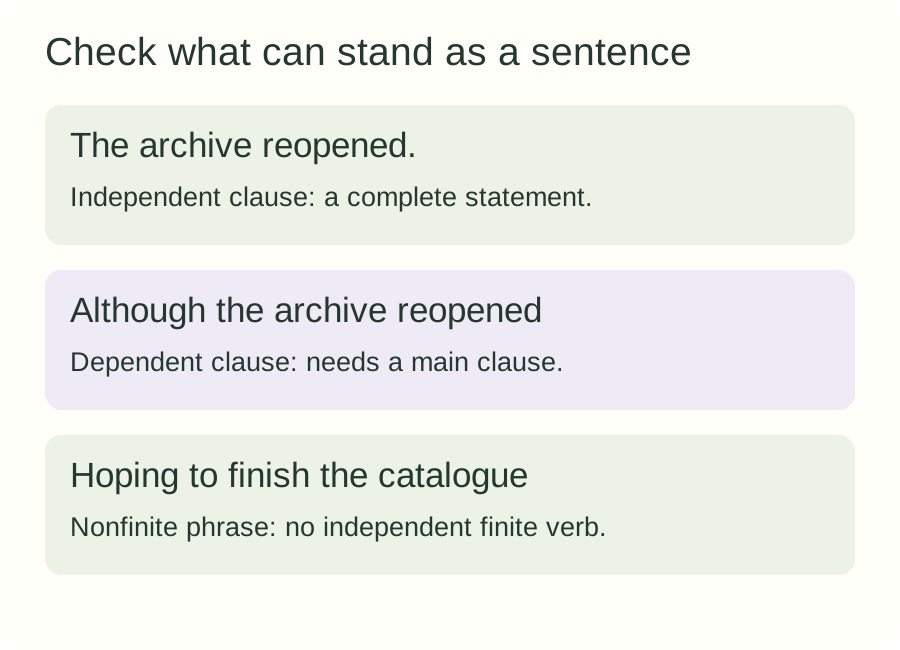
Independent clause: The archive reopened.
Dependent clause: Although the archive reopened.
Nonfinite phrase: Hoping to finish the catalogue.
The first example has a subject, archive, and a finite verb, reopened, and it expresses a complete thought. The second example has the same subject and verb, but the word although makes the clause dependent. It leaves the reader expecting a main clause. The third example has no finite verb at all. Hoping is a nonfinite participle, and the phrase cannot serve as a sentence.
The clause-first method works like this. When you see a punctuation question, locate the finite verbs. Identify the subject of each finite verb. Determine whether each clause is independent or dependent. Then apply the punctuation rule that matches the relationship between the clauses or phrases.
Length and pauses are unreliable guides to sentence boundaries. A short sentence can contain two complete clauses; a long one can contain only one. Purdue OWL’s clause reference explains the structural distinction. Apply it to the original examples here rather than choosing a mark because you would pause there.
Fragments and run-ons
A fragment is a group of words that is punctuated as a sentence but lacks an independent clause. A run-on is two or more independent clauses joined without the correct punctuation or conjunction.
Original fragment examples:
Fragment: Because the sensor recorded unusual readings throughout the night.
Correct: Because the sensor recorded unusual readings throughout the night, the technician recalibrated the instrument.
The fragment begins with because, which makes the clause dependent. It needs a main clause to complete the thought. The corrected version adds the main clause the technician recalibrated the instrument after the introductory dependent clause.
Fragment: The researcher analyzing the sediment samples under a microscope.
Correct: The researcher was analyzing the sediment samples under a microscope.
The fragment has a subject, researcher, but the verb analyzing is nonfinite. The corrected version adds the finite verb was.
Run-on examples:
Run-on: The museum closed its east wing, the renovation had begun.
Correct: The museum closed its east wing because the renovation had begun.
Correct: The museum closed its east wing; the renovation had begun.
Correct: The museum closed its east wing, for the renovation had begun.
The run-on joins two independent clauses with only a comma. The first correction uses because to make the second clause dependent. The second correction uses a semicolon. The third correction uses a comma plus the coordinating conjunction for.
Run-on: The train arrived late the passengers waited on the platform.
Correct: The train arrived late, and the passengers waited on the platform.
Correct: The train arrived late; the passengers waited on the platform.
Correct: The train arrived late. The passengers waited on the platform.
The original has no punctuation between two independent clauses. Each correction uses a valid boundary.
When you identify a run-on, you have several valid fixes. You can make one clause dependent, add a comma plus a coordinating conjunction, use a semicolon, or use a period. The correct answer on the SAT will be the one that preserves the intended meaning and follows standard conventions. You do not need to memorize a single fix; you need to recognize which option is valid.
Comma plus coordinating conjunction
A comma followed by a coordinating conjunction can join two independent clauses. The coordinating conjunctions are for, and, nor, but, or, yet, and so. The memory aid FANBOYS can help you recall them, but recognizing what the word connects is the useful part.
Compare these original sentences:
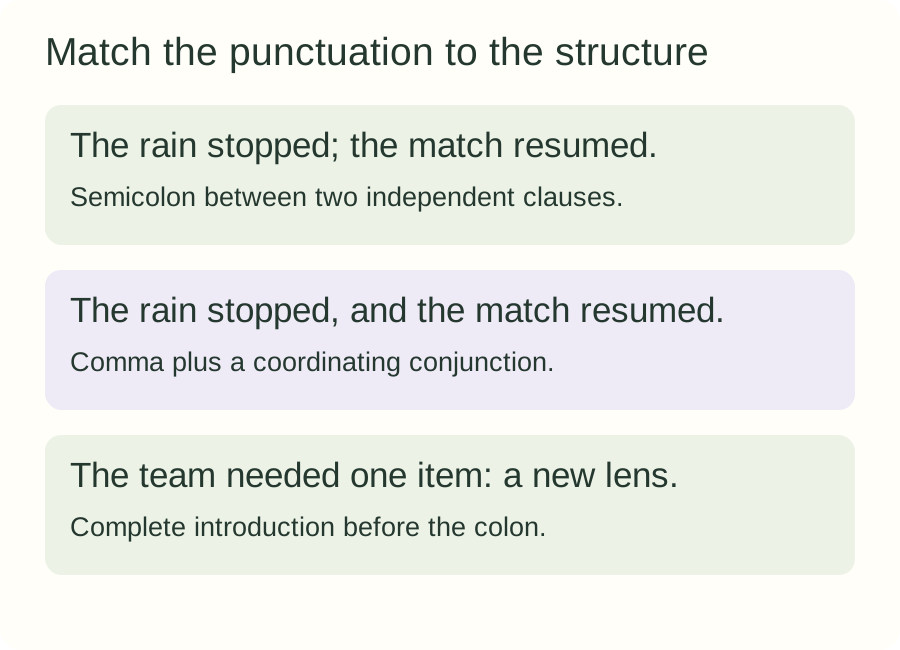
The curator approved the exhibit, and the installation began immediately.
The curator approved the exhibit and began the installation immediately.
In the first sentence, the curator approved the exhibit and the installation began immediately are each independent clauses. The comma plus and connects them. In the second, one subject, curator, performs two actions: approved and began. There is no second independent clause, so the ordinary construction does not need a comma before and.
Another pair makes the difference visible:
The storm damaged the greenhouse, but the seedlings survived.
The storm damaged the greenhouse but spared the shed.
The first sentence has two subjects with finite verbs: storm damaged and seedlings survived. The second has a shared subject with two predicates: damaged and spared. Adding a comma merely because but appears would miss that difference.
Use this distinction as your starting check, rather than an absolute claim about every comma in English. A sentence can contain a separate parenthetical element or a construction where punctuation prevents a misreading. Read the whole sentence before deciding that the conjunction alone determines the mark. Purdue’s comma and semicolon guide supports the basic two-clause pattern.
For a practice question, mark the complete thoughts on each side. If both are independent and the supplied option uses a coordinating conjunction appropriately, comma plus conjunction is a candidate. Then check whether the conjunction preserves the intended relationship. But signals contrast, while so can connect a cause to its result.
Semicolons and conjunctive adverbs
A semicolon can join two independent clauses when the second clause is closely related to the first. The semicolon replaces a period but keeps the two clauses in one sentence to show a tighter connection.
Original examples:
Correct: The survey was brief; however, the interviews were detailed.
Correct: The survey was brief. However, the interviews were detailed.
Both are valid. The semicolon version keeps the contrast within one sentence. The period version creates two sentences. Both use however correctly as a conjunctive adverb.
A conjunctive adverb is not a coordinating conjunction. Words like however, therefore, moreover, consequently, and nevertheless cannot join two independent clauses with only a comma. Check this distinction whenever an answer choice uses one of these words between complete clauses.
Incorrect: The survey was brief, however, the interviews were detailed.
This is a comma splice. The word however is not a coordinating conjunction, so a comma before it cannot join two independent clauses. The correct options are a semicolon before however and a comma after it, or a period before however and a comma after it.
Original contrast pair:
The results were inconclusive; therefore, the team repeated the experiment.
The results were inconclusive, so the team repeated the experiment.
In the first sentence, therefore is a conjunctive adverb. In the construction shown, a semicolon precedes therefore and a comma follows it. In the second sentence, so is a coordinating conjunction. It requires a comma before it and no comma after it.
A well-constructed practice item should have one best answer based on the complete sentence and its capitalization. You cannot distinguish two otherwise identical grammatical options merely by preferring the style of a period or a semicolon. If both seem valid, inspect the rest of each choice before inventing a rule that bans one mark.
Semicolons also separate items in a list when the items themselves contain commas. This is a separate use of semicolons; the pieces of a complex list need not each be independent clauses.
Original example:
Correct: The conference included speakers from Austin, Texas; Portland, Oregon; and Albany, New York.
The semicolons separate the three city-state pairs so the reader can tell where each item ends.
Colons after complete introductory clauses
A colon can introduce a list, an explanation, or a quotation, but the words before the colon must form a complete independent clause. This rule is simple to state and frequently violated in incorrect answer choices.
Original examples:
Correct: The team needed one item: a replacement lens.
Incorrect: The team needed: a replacement lens.
In the correct version, The team needed one item is an independent clause. The colon introduces the specific item. In the incorrect version, The team needed is not a complete thought because needed is a transitive verb that requires an object. The colon breaks the verb-object boundary.
Original contrast pair:
The recipe requires three ingredients: flour, yeast, and salt.
The recipe requires: flour, yeast, and salt.
The first sentence is correct because The recipe requires three ingredients is a complete clause. The second sentence is incorrect because the colon separates the verb requires from its object.
This rule also applies to colons that introduce explanations.
Correct: The delay had a simple cause: the shipment arrived without a packing slip.
Correct: The delay had a simple cause. The shipment arrived without a packing slip.
Both are valid. The colon version emphasizes that the second clause explains the first.
In an ordinary sentence, do not put a colon immediately after such as or including when it separates that introductory phrase from the items it introduces. Check the complete structure rather than memorizing a ban on a particular word occurring near a colon.
Incorrect: The store sells many items, such as: batteries, tape, and rope.
Correct: The store sells many items, such as batteries, tape, and rope.
The colon after such as is incorrect because such as already signals that examples follow.
Essential and nonessential information
Commas, parentheses, and dashes can set off nonessential information. Essential information is not set off with punctuation. The distinction depends on whether the information identifies the noun in the context. Purdue’s comma reference explains the underlying restrictive and nonrestrictive distinction.
Original examples:
Nonessential: The lead researcher, who joined the institute in 2019, presented the findings.
Essential: The researcher who joined the institute in 2019 presented the findings.
Assume the project has one identified lead researcher. In that context, who joined the institute in 2019 adds nonessential information about a person already identified. The clause adds extra information. It is set off with paired commas. In the second, assume several researchers are possible and the date identifies which one is meant. The clause restricts the meaning.
The SAT tests this distinction by asking you to add, remove, or reposition commas. The clause-first method helps because you first identify whether the clause is restrictive or nonrestrictive.
Original contrast pair:
The painting that hung in the lobby was sold at auction.
The painting, which hung in the lobby, was sold at auction.
In the first sentence, that hung in the lobby is essential. It tells the reader which painting. No commas are used. In the second sentence, which hung in the lobby is nonessential. The reader already knows which painting is meant, and the clause adds extra information. Paired commas are used.
A note on dashes: the SAT may present syntactically valid dash choices for nonessential information. Dashes can set off nonessential elements in the same way commas or parentheses can. Recognize that a pair of dashes can correctly set off a nonessential element. If comma and dash options both appear, compare all their surrounding words and marks; do not assume one punctuation style must always be wrong.
No comma between subject and verb or verb and object
In the ordinary sentence constructions shown here, do not separate a subject from its verb or a verb from its object with a single comma. A genuine inserted element can require its own paired punctuation. This rule catches many incorrect answers.
Original examples:
Incorrect: The list of donated books, is on the desk.
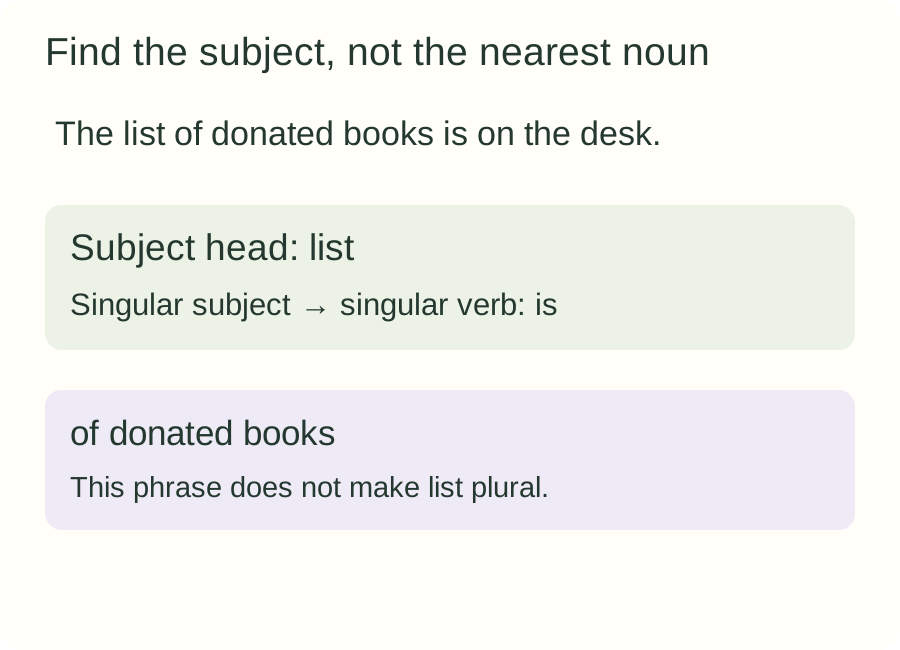
Correct: The list of donated books is on the desk.
The comma separates the subject list from the verb is. No comma is needed because the prepositional phrase of donated books is part of the subject.
Incorrect: The technician replaced, the damaged sensor.
Correct: The technician replaced the damaged sensor.
The comma separates the verb replaced from its object the damaged sensor. No comma is needed.
The exception is when a nonessential element is inserted between subject and verb or verb and object. In that case, the element is set off with paired commas.
Correct: The technician, despite the late hour, replaced the damaged sensor.
Correct: The technician replaced, despite the late hour, the damaged sensor.
The first sentence has a nonessential phrase between subject and verb, set off with paired commas. The second sentence has the same phrase between verb and object, also set off with paired commas. The key is that the commas come in pairs. A single comma between subject and verb or verb and object is almost always wrong.
Introductory dependent clauses and logical subordination
An introductory dependent clause is normally followed by a comma. This comma signals that the main clause is about to begin.
Original examples:
Correct: Although the archive reopened, the public entrance remained closed.
Correct: When the temperature dropped, the pipes froze.
Incorrect: Although the archive reopened the public entrance remained closed.
The incorrect version omits the comma after the introductory dependent clause, making the sentence harder to parse and violating standard convention.
For the introductory dependent-clause constructions shown here, keep the separating comma. Do not extend this into a rule requiring commas after every introductory word or short phrase.
Logical subordination means choosing the subordinating conjunction that matches the logical relationship between the clauses. Words like because, although, when, if, unless, and while each signal a different relationship. The SAT may test whether the conjunction matches the intended meaning.
Original contrast pair:
Because the bridge was closed, the bus took a detour.
Although the bridge was closed, the bus took a detour.
Both sentences are grammatically correct, but they mean different things. The first says the closure caused the detour. The second says the detour happened despite the closure. The correct choice depends on the intended meaning, which the surrounding context will make clear.
The clause-first method separates this decision from punctuation. First identify the clauses. Then check whether the subordinating conjunction matches the logical relationship. Then apply the comma rule.
Subject-verb agreement with distance and compound subjects
Subject-verb agreement follows the grammatical subject, not the nearest noun. This rule is tested frequently with prepositional phrases and other modifiers between the subject and the verb.
Original examples:
Correct: The list of donated books is on the desk.
Incorrect: The list of donated books are on the desk.
The subject is list, which is singular. The plural noun books is the object of the preposition of and does not affect agreement. The verb is must be singular.
Original contrast pair:
The list of donated books is on the desk.
The donated books are on the desk.
In the first sentence, the singular subject list takes the singular verb is. In the second sentence, the plural subject books takes the plural verb are. The presence of donated does not change the number of the subject.
Two distinct people or things joined by and normally take a plural verb. A coordinated expression naming one person or one unit can behave differently, so interpret the subject as well as locating and.
Correct: The curator and the archivist are reviewing the collection.
Compound subjects joined by or or nor follow the number of the part closer to the verb.
Correct: Either the manager or the employees are responsible.
Correct: Either the employees or the manager is responsible.
In the first sentence, employees is closer to the verb and is plural, so are is correct. In the second sentence, manager is closer and is singular, so is is correct.
Other agreement challenges include indefinite pronouns, collective nouns, and inverted sentences.
Indefinite pronouns like each, everyone, anybody, and nobody are singular.
Correct: Each of the volunteers has a schedule.
Correct: Everyone in the two departments knows the procedure.
Collective nouns like team, committee, and staff are usually singular when the group acts as a unit.
Correct: The committee meets on Thursday.
Inverted sentences place the subject after the verb. Locate the subject before choosing the verb form.
Correct: On the desk are the donated books.
The subject is books, which is plural, so are is correct. The phrase on the desk is a prepositional phrase, not the subject.
Tense and aspect in context, not blanket uniformity
The SAT does not require all verbs in a sentence or passage to be in the same tense. It requires the tense and aspect to match the time relationships the sentence expresses. When the time changes, the tense changes.
Original examples:
Correct: The device failed yesterday and is working today.
The first verb, failed, is past tense because the failure happened yesterday. The second verb, is working, is present progressive because the working is happening today. The different tenses are legitimate because the time references differ.
Correct: By the time the technician arrived, the system had already shut down.
The past perfect had shut down places the shutdown before the arrival. The simple past arrived places the arrival at a specific past time. The sequence is correct.
The past perfect makes the earlier shutdown explicit. However, simple past can also describe ordered events when the surrounding words establish the chronology. Do not reject a form just because two actions happened in the past; examine the particular choices and time clues.
Aspect refers to whether an action is completed, ongoing, or habitual. The SAT may test the difference between simple past and past perfect, or between simple present and present progressive.
Original contrast pair:
The scientist records data every hour.
The scientist is recording data right now.
The first sentence uses simple present for a habitual action. The second uses present progressive for an action in progress. Both are correct in their contexts.
The rule is not to make all tenses match. The rule is to make each tense match its own time reference and the sequence of events.
Pronoun agreement and clear antecedents
A pronoun needs an interpretable referent and a form that fits the sentence. Begin with what the pronoun refers to. Do not choose from the word nearest the blank without checking the passage.
Original pair:
The two researchers submitted their reports.
The two researchers submitted its reports.
Their refers to the two people. Its does not fit that plural personal referent. This example tests a clear number relationship rather than an assumption about a person’s gender.
Singular they is accepted in contemporary English; APA’s usage guidance explains that use. A sentence such as Each researcher submitted their report is not automatically wrong because researcher is singular. Avoid treating a modern pronoun choice as an error on the basis of a blanket prohibition. Test the actual agreement, reference, and meaning in the sentence you receive.
Reference can be unclear even when a pronoun’s form is grammatical:
The manager told the technician that he needed to revise the report.
Without context, he could refer to either person. If the technician needs to revise it, write The manager told the technician to revise the report. If the manager needs to revise it, write The manager needed to revise the report and told the technician so. These revisions make different meanings explicit.
Case is another check. In The award was given to the researcher and me, the pronoun is part of the object of to. Removing the other person briefly gives The award was given to me, which helps identify the object form. The researcher and I would not fit that position.
Use these tests for the question actually asked. A pronoun can be perfectly grammatical in isolation and still refer to the wrong person or thing in a passage. Conversely, repeating a noun is sometimes clearer, but repetition is not automatically superior to a well-chosen pronoun.
Apostrophes with possessives and its versus it's
Apostrophes show possession for nouns and indefinite pronouns. They do not show possession for personal pronouns. The contraction it's means it is or it has. The possessive its has no apostrophe.
Original examples:
Singular possessive: the researcher's notes
Plural possessive: the researchers' notes
Singular: One researcher makes notes. The notes belong to one researcher: the researcher's notes.
Plural: Several researchers make notes. The notes belong to several researchers: the researchers' notes.
The apostrophe placement depends on whether the noun is singular or plural before the possessive is formed.
Original contrast pair:
The device lost its cover.
It's open now.
In the first sentence, its is a possessive pronoun. No apostrophe. In the second sentence, it's is a contraction of it is. The apostrophe replaces the missing letter.
Incorrect: The device lost it's cover.
This is wrong because it's means it is, which does not fit the possessive meaning.
Possessive pronouns like yours, hers, ours, and theirs never take apostrophes.
Correct: The decision is theirs.
Incorrect: The decision is their's.
For nouns ending in s, style conventions can affect the preferred possessive form. Check the applicable construction instead of using that variation to reject an otherwise standard answer. Irregular plurals also matter: children is already plural, and its possessive is children’s, with an apostrophe plus s.
Modifiers attached to the noun they modify
A modifying phrase should be placed next to the noun it modifies. A dangling modifier is a phrase that has no clear noun to modify in the sentence. A misplaced modifier is a phrase that is next to the wrong noun.
Original examples:
Correct: Walking into the archive, Mira noticed the damaged box.
Incorrect: Walking into the archive, the damaged box caught Mira's attention.
In the incorrect version, the phrase Walking into the archive appears to modify the damaged box, which cannot walk. The modifier dangles because the intended subject, Mira, is not the noun that follows the phrase.
Correct: The technician examined the sensor with a cracked casing.
Correct: The technician with a cracked casing examined the sensor.
The first sentence means the sensor has a cracked casing. The second sentence means the technician has a cracked casing, which is unlikely but grammatically possible. The placement of the phrase changes the meaning.
The SAT tests whether the modifier is placed so that the intended meaning is clear.
Original contrast pair:
After reviewing the data, the team published the results.
After reviewing the data, the results were published by the team.
The first sentence is correct because the team reviewed the data and published the results. The second sentence is incorrect because the phrase After reviewing the data appears to modify the results, which cannot review data.
The fix is to place the noun that performs the action of the modifying phrase immediately after the phrase.
Parallel structure
Parallel structure gives coordinated items matching grammatical roles, as described in Purdue’s parallel-structure guide. The SAT tests whether verbs, nouns, phrases, or clauses in a series are parallel.
Original examples:
Correct: They measured the samples, recorded the temperatures, and compared the results.
Incorrect: They measured the samples, recorded the temperatures, and comparing the results.
The first sentence has three past-tense verbs: measured, recorded, and compared. The second sentence breaks the pattern with the nonfinite form comparing.
Parallel structure does not require every word to have an identical ending. It requires matching grammatical roles.
Correct: The intern was responsible for filing documents, answering phones, and organizing the supply closet.
The three items are gerund phrases: filing documents, answering phones, and organizing the supply closet. They match in form.
Correct: The report was thorough, accurate, and clearly written.
The three items are adjectives or adjective phrases. They match in role even though clearly written has a different surface pattern.
Incorrect: The report was thorough, accurate, and with clear writing.
The third item, with clear writing, is a prepositional phrase, not an adjective. It breaks the parallel structure.
Parallelism also applies to paired constructions like either/or, neither/nor, not only/but also, and both/and.
Correct: The study was not only expensive but also time-consuming.
Incorrect: The study was not only expensive but also it took a lot of time.
The first version pairs two adjectives. The second version pairs an adjective with a clause, breaking the parallel structure.
Transitions and the grammar-meaning boundary
Transition questions on the SAT belong to the Expression of Ideas domain, not Standard English Conventions. They test whether a transition word matches the logical relationship between sentences or clauses. Grammar questions test whether the sentence is correctly formed. The clause-first method keeps these separate.
A transition word like however, therefore, for example, or in addition signals a relationship. The correct transition depends on the meaning of the surrounding sentences.
Original examples:
The first trial produced inconsistent results. Therefore, the team redesigned the experiment.
The first trial produced inconsistent results. However, the team proceeded with the original design.
Both sentences are grammatically correct. The first uses therefore to signal a cause-effect relationship. The second uses however to signal a contrast. The correct choice depends on the intended meaning.
The SAT will not ask you to choose between two grammatically valid transitions without giving you enough context to determine the logical relationship. Read the surrounding sentences before choosing.
Grammar questions with transitions often involve punctuation. When however opens the second of two independent clauses in these examples, use a semicolon before it and a comma after it, or a period and appropriate capitalization.
Correct: The results were unexpected; however, the team proceeded.
Correct: The results were unexpected. However, the team proceeded.
Incorrect: The results were unexpected, however, the team proceeded.
The incorrect version is a comma splice. The transition word however is not a coordinating conjunction, so a comma cannot join the two independent clauses.
Concision only when meaning and grammar are retained
When answer choices differ in length, evaluate the task and meaning before preferring the shorter one. The rule is not that the shortest answer is always correct. The rule is that the best answer expresses the intended meaning without unnecessary words and without introducing errors.
Original examples:
Wordy: The reason for the delay was because the shipment arrived late.
Concise: The delay occurred because the shipment arrived late.
Concise: The reason for the delay was that the shipment arrived late.
The wordy version uses the redundant construction reason was because. The concise versions remove the redundancy.
Wordy: The committee made a decision to postpone the meeting.
Concise: The committee decided to postpone the meeting.
The concise version replaces the noun phrase made a decision with the verb decided.
However, concision does not justify removing necessary information or changing the meaning.
Original contrast pair:
The researcher who studied the samples found a discrepancy.
The researcher found a discrepancy.
The second sentence is shorter, but it omits the essential information that the researcher studied the samples. If that information is necessary to the passage, the shorter version is not better.
Read the stated editing or rhetorical goal alongside grammatical fit. Do not choose an answer only because it is the shortest.
Quick rule table
| Structure | Rule | Original example |
|---|---|---|
| Two independent clauses | Use semicolon, or comma plus coordinating conjunction, or period | The storm damaged the greenhouse, but the seedlings survived. |
| Independent clause plus dependent clause | No comma when dependent clause follows and is essential; comma when dependent clause is introductory | Although the archive reopened, the public entrance remained closed. |
| Conjunctive adverb between clauses | Semicolon before, comma after; or period before, comma after | The survey was brief; however, the interviews were detailed. |
| Colon | Complete independent clause before the colon | The team needed one item: a replacement lens. |
| Nonessential element | Paired commas, parentheses, or dashes | The lead researcher, who joined in 2019, presented the findings. |
| Essential element | No commas | The researcher who joined in 2019 presented the findings. |
| Subject and verb | No single comma between them | The list of donated books is on the desk. |
| Verb and object | No single comma between them | The technician replaced the damaged sensor. |
| Introductory dependent clause | Comma after it | When the temperature dropped, the pipes froze. |
| Two distinct people joined by and | Plural verb | The curator and the archivist are reviewing the collection. |
| Compound subject with or/nor | Verb agrees with closer subject | Either the employees or the manager is responsible. |
| Possessive singular noun | Apostrophe plus s | the researcher's notes |
| Regular plural noun ending in s | Apostrophe after s | the researchers' notes |
| Its vs it's | its is possessive; it's means it is or it has | The device lost its cover. It's open now. |
| Parallel list | Matching grammatical form | They measured the samples, recorded the temperatures, and compared the results. |
Original multiple-choice practice items
These twelve original items are for instruction. They are not official questions or a calibrated test. Insert each choice exactly as written, preserving the capitalization in the sentence. An option labeled (no punctuation) means to insert nothing. Each item has one best answer; the key appears after all twelve.
Item 1
The museum team restored the mural______ the neighborhood celebrated its return. The restoration and celebration are separate complete statements in this sentence.
- A. .
- B. ,
- C. ;
- D. because;
Item 2
The director of the three research programs, who has worked at the institute since 2011, ______ the annual budget report. The report describes all three programs.
- A. prepare
- B. have prepared
- C. are preparing
- D. prepares
Item 3
The laboratory ordered all three required items______ microscopes, centrifuges, and a refrigerated storage unit. The catalogue lists those items separately, but the delivery arrived in one shipment.
- A. ;
- B. :
- C. .
- D. and because
Item 4
Walking through the greenhouse, ______. The botanist then photographed the affected plant and added a description of it to the field notebook.
- A. the orchid leaves showed an unusual pattern
- B. the botanist noticed discolored leaves
- C. the photographs showed discolored leaves
- D. an unusual pattern appeared on the orchid leaves
Item 5
Yesterday, the committee reviewed the proposal, discussed the budget, and ______ a final vote before leaving. The minutes record all three actions as completed during the same meeting.
- A. will take
- B. taking
- C. to take
- D. took
Item 6
Each of the volunteers ______ a schedule for the weekend shift. The coordinator gives one copy to every person before explaining the individual assignments.
- A. have
- B. are having
- C. has
- D. were having
Item 7
The archive’s oldest map lost ______ protective covering during the move. A conservator placed the map in a new sleeve before returning it to the cabinet.
- A. it’s
- B. its’
- C. its
- D. it is
Item 8
The botanist repeated the measurement each day______ however, the readings remained unchanged. The second clause contrasts the repeated effort with the absence of a change in the observations.
- A. ,
- B. ;
- C. although
- D. (no punctuation)
Item 9
The shipment arrived without a packing slip, ______ the warehouse manager could not verify the order. The missing document prevented the normal comparison with the order record.
- A. moreover
- B. however
- C. therefore
- D. so
Item 10
The notes belonged to a single researcher. The folder contained the ______ original sketches, which the archive planned to store with that person’s field notebook.
- A. researcher’s
- B. researchers’
- C. researchers
- D. researcher
Item 11
By the time the technician arrived, the automated system ______ itself down. The log showed that shutdown had been completed ten minutes before the arrival.
- A. had already shut
- B. was still shutting
- C. has already shut
- D. will already shut
Item 12
Mira and Jonas planned to compare the catalogue entries with the photographs. The archivist asked ______ to finish the comparison together before closing time.
- A. them
- B. their
- C. themselves
- D. they
Answer key with explanations
Item 1
Correct answer: C. Both sides are independent clauses. The semicolon joins them. A comma alone makes a comma splice. The period would leave the following word, the, incorrectly lowercase. Because followed by a semicolon separates the subordinator from its clause and does not supply a valid boundary.
Item 2
Correct answer: D. Director is the singular subject of the main clause. The of phrase and the inserted who clause do not make that subject plural. Prepares agrees with director. Prepare, are preparing and have prepared do not agree with that singular subject in this construction.
Item 3
Correct answer: B. The complete clause before the blank introduces a list. The colon fits. The list itself is not an independent clause, so a semicolon cannot join it as a second clause. A period produces a fragment and incorrect capitalization. And because introduces an incomplete dependent construction.
Item 4
Correct answer: B. The introductory phrase describes the walker. The botanist can walk through the greenhouse and notice leaves. The other options make leaves, a pattern or photographs the grammatical subject after the modifier. None is the intended person performing that action.
Item 5
Correct answer: D. The sentence coordinates completed actions under one subject. Took supplies the finite past-tense verb parallel to reviewed and discussed. Taking and to take do not supply the required parallel finite form. Will take conflicts with the explicitly completed actions yesterday, rather than describing another stated future event.
Item 6
Correct answer: C. Each is the head of the subject here and takes singular has. Volunteers is inside an of phrase and does not determine this verb’s number. Have, are having and were having do not agree with the singular subject in this construction. In They each have a copy, by contrast, they is the subject.
Item 7
Correct answer: C. The blank needs a possessive form connecting the map with its covering. Its has that function without an apostrophe. It’s expands to it is or it has, neither of which fits here. Its’ is not the standard possessive spelling, and it is cannot modify protective covering in this sentence.
Item 8
Correct answer: B. The two complete clauses need a valid boundary. The semicolon before however and comma after it provide one. A comma alone would leave a comma splice; no punctuation would create a fused sentence. Although immediately followed by however does not form the supplied relationship into a valid construction.
Item 9
Correct answer: D. So is a coordinating conjunction that joins these complete clauses after the supplied comma and expresses the result. However, therefore and moreover are conjunctive adverbs. A comma before one of them does not by itself join two independent clauses. Therefore has a plausible meaning, but its punctuation would still be wrong here.
Item 10
Correct answer: A. The context specifies one owner, so use the singular possessive researcher’s. Researchers’ indicates multiple owners. Researchers without an apostrophe is a plural noun rather than the required possessive, while researcher alone does not supply the ownership construction requested before original sketches.
Item 11
Correct answer: A. Had already shut locates a completed shutdown before another past event. Has already shut uses a present-perfect reference that does not fit the stated past sequence. Was still shutting conflicts with the explicitly completed shutdown. Will already shut puts the action in a future frame not established by the sentence.
Item 12
Correct answer: A. Asked needs an object referring to Mira and Jonas, so them is correct. They is a subject form, and their is possessive. Themselves would require a suitable reflexive relationship with the subject; the subject here is the archivist, not Mira and Jonas.
Review and FAQs
Can I choose punctuation by the pause I hear?
Use the sentence structure first. Mark its finite verbs, identify their subjects and check what each clause does. An independent clause can support a sentence boundary; an unfinished dependent clause cannot. A natural pause may coincide with punctuation, but the pause alone does not decide which mark fits.
Are a period and a semicolon interchangeable?
They can both separate independent clauses, with appropriate capitalization. A semicolon can also separate items in a complex list, which is a different construction. Compare the full options. You do not need a rule declaring one mark universally stronger or more correct than the other.
What if the closest noun is plural?
Find the subject head. In The list of donated books is on the desk, list controls agreement. In The donated books are on the desk, books controls it. Purdue’s agreement guide provides background; use your own sentences to check whether you can identify the subject rather than a keyword.
Should I choose the shortest answer?
Only when it also fits the requested meaning, grammar and rhetorical goal. A concise option can omit a necessary condition. A longer one can contain needed identifying information. Explain why the retained words are necessary before calling the other option wordy.
What should I do after checking the practice key?
Select one error and describe it precisely. For a boundary error, write the clauses on separate lines and label them. For agreement, identify the subject head. For tense, draw the sequence of events. Then try a new question without the answer beside you. Immediate correction rehearses a method; a later independent attempt checks whether you can choose it again.
A practical 25-minute session
Use this session to practice the clause-first method with official materials or the original items in this article.
Minutes 0 to 3: Review the quick rule table. Read each rule and the original example. Do not try to memorize every rule. Focus on the clause-first sequence: find finite verbs, identify subjects, classify clauses, then apply punctuation.
Minutes 3 to 10: Work through items 1 through 6 in the practice set. For each item, write down the clause structure before looking at the choices. Identify whether each clause is independent or dependent. Then eliminate choices that create fragments, run-ons, comma splices, or agreement errors.
Minutes 10 to 15: Check your answers against the answer key. For each item you missed, write one sentence explaining why the correct answer is correct and why your choice is wrong. Do not skip this step. The explanation is where the learning happens.
Minutes 15 to 20: Work through items 7 through 12 using the same method. For each item, identify the grammar rule being tested before looking at the choices.
Minutes 20 to 25: Check your answers and write one sentence for each missed item. Then review the FAQ section for any rule you found difficult.
This session is not an official timed SAT section. The Student Question Bank offers official practice questions filtered by domain, skill, and difficulty. Use the Student Question Bank for official skill practice and Bluebook for full adaptive practice. The original items in this article are instructional and are not validated to official exam difficulty.
If you are also planning Math preparation, the Aporo Math study plan provides a separate schedule for that section.
Sources and scope
An AI-assisted guide edited and checked by Aporo. Practice questions, worked examples, illustrative data and proposed routines are original. These are instructional resources, not official questions or calibrated score predictions. Linked sources support the test facts and reference guidance. Illustrations are explanatory, not screenshots or learner results. No score gain is promised.
- College Board: SAT structure
- College Board: Student Question Bank
- College Board: Bluebook practice tests
- College Board: Reading and Writing
- Purdue OWL: independent and dependent clauses
- Purdue OWL: commas and semicolons
- Purdue OWL: subject-verb agreement
- Purdue OWL: extended comma rules
- Purdue OWL: parallel structure
- APA Style: singular they